Note: This website was automatically translated, so some terms or nuances may not be completely accurate.
 Reflecting on Japan's Present and Future Through the 2019 Japan Brand Survey [2/7]
What Is the Image of Japan? ~Exploring Perceptions of Japan~
It seems that many people overseas have images of Japan as “hardworking,” “polite,” and “high-quality” (according to the 2016 Japan Brand Survey).
I think the stories about Japan that are spreading—such as how people remain calm during major disasters and the speedy cleaning service on the Shinkansen—are further reinforcing that image.
It’s tempting to think, “People have a high regard for Japan, and its image is positive. Could it be that Japan is actually seen as a really great country?” But is that really the case?
This series explores insights for the future of the inbound tourism business based on the “Japan Brand Survey 2019,” conducted in 20 countries and regions in December 2018. In this second installment, we take a closer look at impressions of Japan from multiple perspectives.
Japan and Diversity: Are “Women,” “Seniors,” and “Foreigners” Thriving?
In recent years, awareness of diversity has been growing within Japan, and various initiatives are underway—but how is this perceived from overseas? We asked about impressions from the perspectives of “women,” “seniors,” and “foreigners.”
First, let’s look at “women.” In the “Gender Gap Index 2018” released by the World Economic Forum—which measures the degree of gender inequality in countries around the world—Japan ranked 110th out of the 149 countries surveyed. It ranked last among the G7 nations.
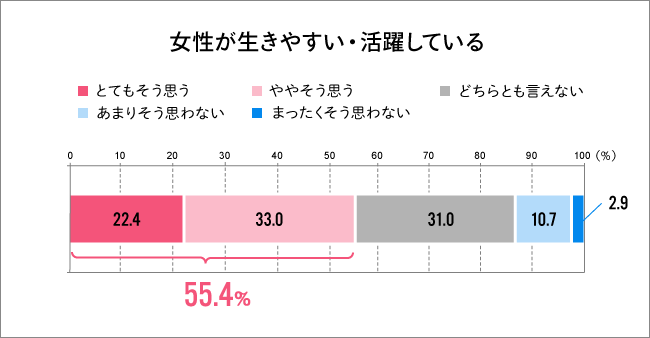
Overall, 55.4% of respondents believed Japan is a country where “women can live comfortably and thrive.” While the score was high in ASEAN countries, which generally hold a favorable view of Japan, it was very low—at 36.7%—in East Asia, where people are more familiar with Japan, particularly in Taiwan, where favorability and experience visiting Japan are high. Could it be that Taiwan’s assessment reflects a more accurate understanding of the actual situation?
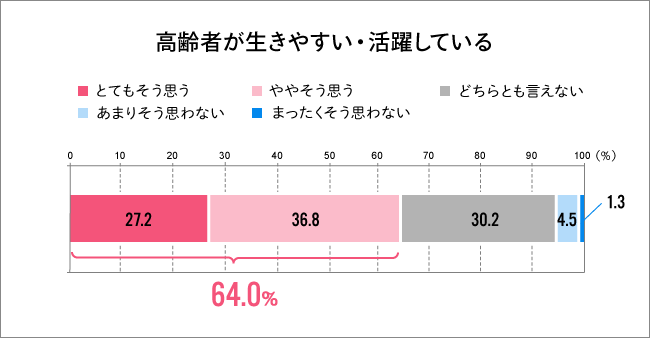
On the other hand, while Japan is known for its aging population, 64.0% of respondents believe it is a country “where the elderly can live comfortably and remain active”—a higher result than the perception regarding “women.” By region, the evaluation from ASEAN was again the highest at 76.4%, followed by Europe at 61.3%.The high evaluation from Europe—which is also grappling with an aging population—may stem from the fact that Japan is recognized as the country with the world’s most advanced aging society, and Europeans are aware that Japanese seniors are actively working thanks to the country’s high standard of medical care.
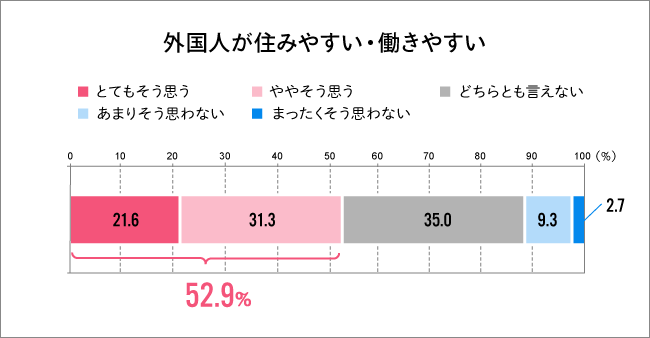
Finally, “foreigners.” While the number of foreign residents has been increasing year by year and now accounts for approximately 2% of Japan’s total population (as of the end of June 2018), only 52.9% of respondents believe that “it is easy for foreigners to live and work in Japan.” This result is even lower than that for “women.”
By country, Germany had the lowest score (38.0%), while by region, North America had the lowest at 43.8%. Although Japan is becoming an increasingly popular travel destination, it still does not appear to be viewed as an attractive place to live.
What is Japan’s influence on the world?
The G20 Summit was held in Osaka at the end of June, but to what extent is Japan perceived as a country with global influence?
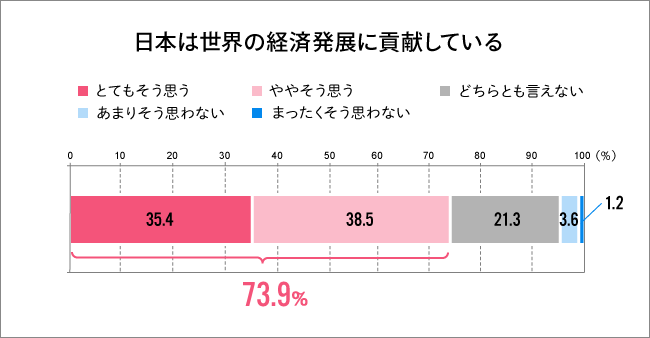
A significant 73.9% of respondents believe that “Japan contributes to the development of the global economy,” with a particularly high score of 85.5% in ASEAN—a region where Japan has provided cooperation and support for many years.
Furthermore, thanks to high ratings from Italy, Russia, and Turkey—countries where many respondents said they “like Japan”—the score for Europe was also high at 74.1%. This suggests that evaluations and expectations regarding Japan’s influence in the economic sphere remain high.
So, what about Japan’s cultural influence, including the current “food” boom?
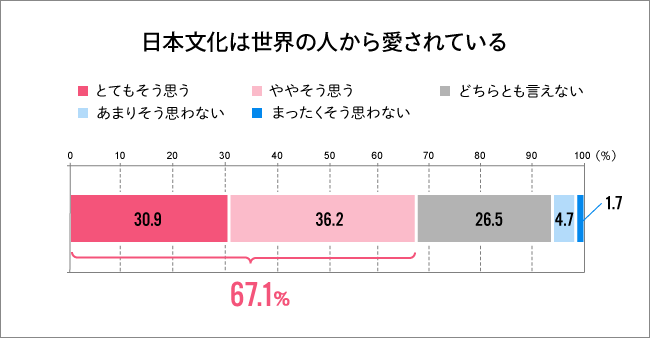
67.1% of respondents believe that “Japanese culture is loved by people around the world,” with particularly high scores among those in their 20s and 30s—the generations set to lead the future (20s: 69.4%, 30s: 72.2%). Interest in Japanese culture is growing, and this suggests that it will continue to take the world by storm and increase its cultural influence in the years to come.
What about Japan’s future prospects and potential?
Following the discussion on global influence, let’s take a brief look at how Japan’s future prospects are evaluated.
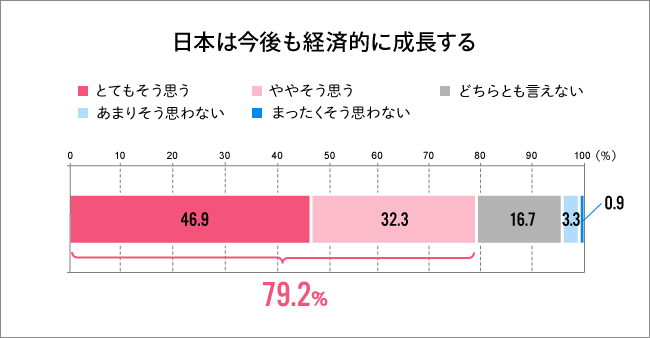
First, regarding economic growth, 79.2% of respondents feel that “Japan will continue to grow economically,” indicating that expectations remain high.
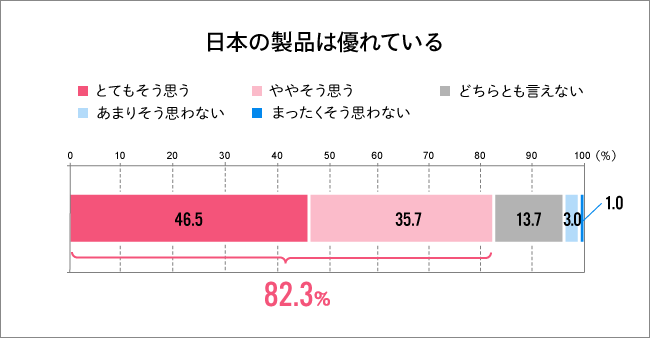
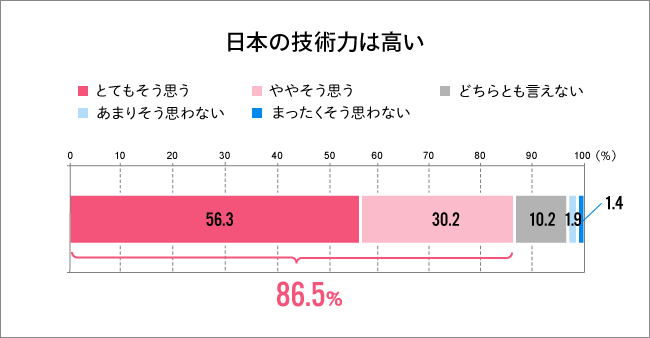
Looking at the results by region, scores were high in ASEAN and Europe, while expectations were relatively lower (61.6%) in East Asia, where Japan is located. This may suggest that China’s presence is particularly strong in East Asia. As for the assessment of Japan’s technological capabilities—an essential factor in discussing its growth potential—82.3% of respondents agreed that “Japanese products are excellent,” and 86.5% agreed that “Japan’s technological capabilities are high,” indicating very high scores in these areas as well.
Let’s also take a look at the global popularity of Japanese content in recent years.
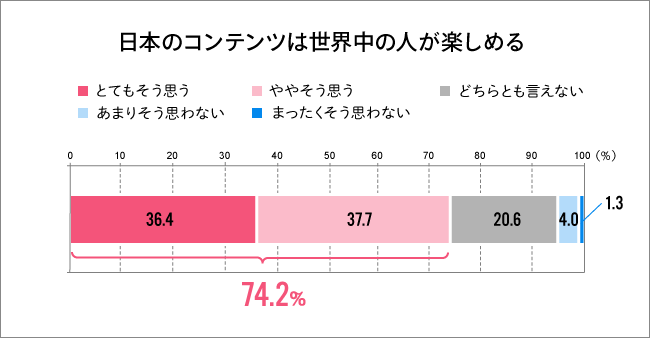
74.2% of respondents believe that “Japanese content can be enjoyed by people all over the world.” The score is high not only in ASEAN but also in North America, at 72.4%.
Looking at individual countries, the figure is particularly high in Thailand at 91.3%, indicating that nearly 90% of people there share this view.
With expectations rising not only for products but also for content, it is clear that, overall, there is still a great deal of optimism regarding Japan’s growth potential.
Through this survey, while Japan still leaves the impression of having room for improvement from a diversity perspective, it was highly rated for its global influence and future growth potential, revealing the high level of expectation the world has for the country.
However, a disappointing trend was also observed: overall evaluations were not particularly high in East Asia—the region closest to Japan and most familiar with it.
While Japan is often perceived as “diligent” and “polite,” as the number of foreign visitors to Japan increases and understanding of the country deepens, that image is likely to continue changing. Going forward, it seems we will need to be increasingly mindful of “how Japan is viewed from abroad.”
[Contact Information for Inquiries Regarding This Matter]
Dentsu Inc., Japan Brand Project Team
japanbrand@dentsu.co.jp
Japan Brand Survey Hub Page
https://www.dentsu.co.jp/knowledge/japan_brand/
[Purpose of the Dentsu Inc. Brand Survey]
Launched in 2011—when the Great East Japan Earthquake led to reputational damage affecting Japanese agricultural and marine products as well as inbound tourism—this is Dentsu Inc.’s proprietary commercial marketing research initiative designed to understand how products and services originating in Japan are perceived globally.The Japan Brand Survey regularly assesses overseas consumers’ perceptions and actual behaviors regarding the Japan brand as a whole, covering areas such as overseas travel, inbound tourism, culture, regional revitalization, Japanese cuisine, Japanese products, and lifestyle. By visualizing shifting consumer sentiments as well as the challenges and potential of the Japan brand, the survey contributes to increasingly complex corporate activities and helps promote cross-cultural understanding within Japanese society.
[Dentsu Inc. Brand Survey 2019: Survey Overview]
・Target Areas: 20 countries and regions (Mainland China, Hong Kong, Taiwan, South Korea, India, Singapore, Thailand, Indonesia, Malaysia, Vietnam, the Philippines, Australia, the United States, Canada, the United Kingdom, France, Germany, Italy, Russia, Turkey)
・Sample Size: 6,600 (Breakdown: United States 600, Mainland China 600, other countries and regions 300 each)
・Survey Period: December 2018
・Eligibility criteria: Men and women aged 20–59 (middle-income bracket and above)
・Survey Method: Online survey
・Research Organizations: Dentsu Inc. (commissioner), Video Research Ltd. (implementation partner)
[Notes and Disclaimers]
*1: The target areas in mainland China were primarily Tier 1 cities; in Australia, the Sydney metropolitan area; and in Southeast Asia, primarily metropolitan areas.
*2: Definition of middle-income group: Criteria were established for each country based on average national income figures (such as OECD statistics) and socio-economic classification (SEC).
*3: Samples were collected using equal allocation by gender and age group in each country and region, and the data was weighted to reflect the population distribution.
*4: Since the composition ratios in this survey are rounded to the second decimal place (or to the first decimal place in some cases where whole numbers are displayed), the totals may not add up to 100%.
*5: In creating the charts and tables for this survey, the names of the countries and regions analyzed use the international standard ISO country codes (ISO 3166-1 alpha-2/3), with a few exceptions.
United States/US/USA, Canada/CA/CAN, Australia/AU/AUS, United Kingdom/UK/GBR, Germany/DE/DEU, France/FR/FRA, Italy/IT/ITA,Spain/ES/ESP, Finland/FI/FIN, United Arab Emirates/UAE, Saudi Arabia/SA/SAU, India/IN/IND, Indonesia/ID/IDN, Singapore/SG/SGP, Malaysia/MY/MYS, Philippines/PH/PHL, Thailand/TH/THA,Vietnam/VN/VNM, Mainland China/CN/CHN, Hong Kong/HK/HKG, Taiwan/TW/TWN, South Korea/KR/KOR, Turkey/TR
*6: The names of countries and regions used in this survey report and on our website are based on the Japanese government’s long-standing position, as well as Japanese social norms and business practices.
*7: The names of countries and regions used in this survey are for statistical or analytical convenience only and do not imply any political stance or opinion.
*8: The maps used in this survey (world map and map of Japan) have been partially modified and cropped to suit the analysis content and page layout; therefore, they may not necessarily reflect national borders and territorial boundaries accurately.
*9: As a commercial marketing research study aimed at understanding the lifestyle habits and brand preferences of general consumers, this survey has been conducted consistently since its inception through commissioned fieldwork partners, in strict compliance with local laws, regulations, and public order and morals.Surveys conducted in China are carried out through fieldwork contractors who have obtained the “Foreign-Related Survey Permit” required by Chinese authorities; our company does not conduct market research activities within China itself. Furthermore, we monitor and review our operational procedures as necessary in light of developments such as changes in laws and regulations.
*10: The response data collected through this survey is obtained, managed, and processed lawfully in accordance with the relevant laws and regulations of each target market. The data we receive consists solely of aggregated data that has been anonymized in a manner that does not allow for the identification of specific individuals and cannot be reversed; it does not contain any personal information.
Was this article helpful?
Share this article


Newsletter registration is here
We select and publish important news every day
For inquiries about this article
Author

Katsura Nakazato
Dentsu Inc.
Fourth Marketing Bureau
Communications Director
Japan Brand Survey 2015Reflecting on Japan's Present and Future Through the 2019 Japan Brand SurveyExploring Japan's Potential Through Dentsu Inc. Japan Brand ResearchGlobal Sentiments and Japanese Identity: Japan Brand Survey 2023Global Sentiment and Japanese Identity: Japan Brand Survey 2024Insights from Overseas Residents in Their 15th Year: Japan Brand Survey 2025