Note: This website was automatically translated, so some terms or nuances may not be completely accurate.
 Reflecting on Japan's Present and Future Through the 2019 Japan Brand Survey [5/7]
What Lies Ahead Beyond 2020? ~ Is It True That the World Expo Will Lead to an Increase in Visitors to Japan? ~
This series explores insights for the future of the inbound tourism business based on the “Japan Brand Survey 2019,” conducted in 20 countries and regions in December 2018. In this installment, drawing on survey results regarding “perceptions of the Osaka-Kansai Expo” and “Japanese products and experiences of interest,” we’ll consider opportunities for inbound tourism from 2020 onward.
About half of respondents are aware of the Osaka-Kansai Expo. About 40% intend to visit!
The 2025 Japan International Exposition (hereinafter referred to as the Osaka-Kansai Expo) will be held in Osaka. This marks the first time in 55 years that the event will be hosted in Osaka. It has become a major topic of conversation, with various developments making headlines.
It seems Japan isn’t the only one paying attention. When asked about the Osaka-Kansai Expo in this survey, 49.5% of respondents across 20 countries and regions were aware that the Expo would be held in Osaka in 2025. This reveals that nearly half of the respondents are aware of it.
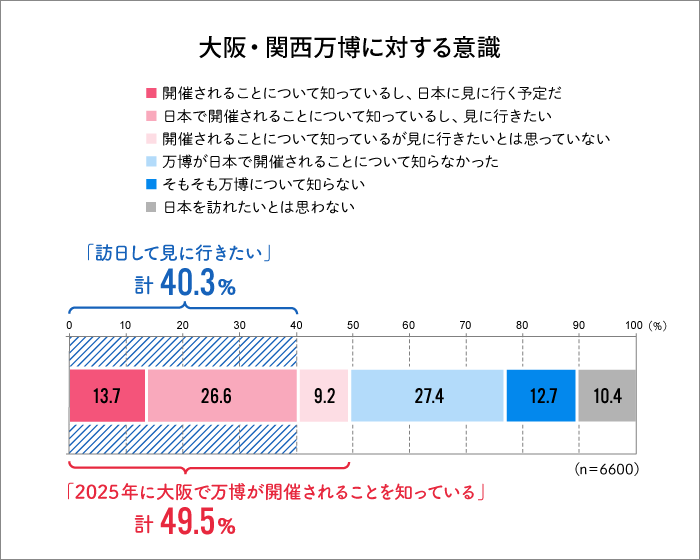
Furthermore, the survey found that 40.3% of respondents expressed a desire to visit Japan to see the Expo (this figure combines those who said, “I know it’s being held in Japan and plan to go,” and those who said, “I know it’s being held in Japan and would like to go”).
Looking at the results by region, in Asia—particularly the ASEAN region—50.2% of respondents, or roughly half, expressed a desire to “visit Japan to see the Expo.” The country with the highest level of interest was Vietnam, at 58.7%. This suggests that the Expo could serve as a catalyst for travel to Japan for just under 60% of people. What lies behind this interest?
Is the high level of interest in the Osaka-Kansai Expo a reflection of interest in Japanese technology?
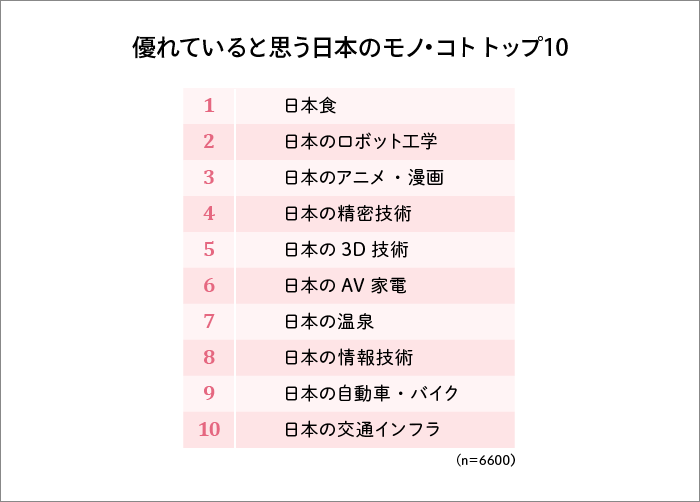
In a survey asking about “Japanese products and experiences that respondents consider outstanding,” “Japanese cuisine” ranked first. “Japanese robotics” came in second, and “Japanese anime and manga” came in third.
Looking at the top 10 items, we can see that more than half are technology-related. When broken down by region, Japanese technology was particularly highly rated in ASEAN, with “Japanese robotics” ranking first, “Japanese cuisine” second, and “Japanese cars and motorcycles” third.
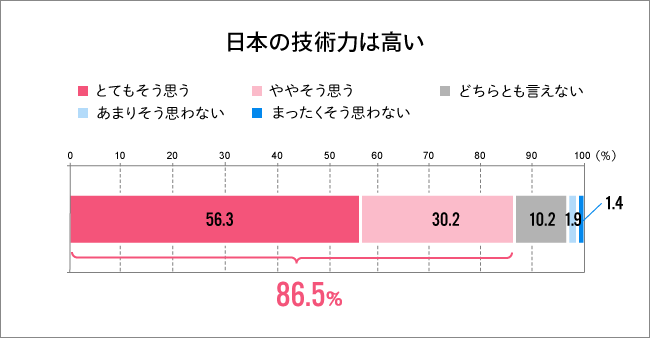
Furthermore, the results showed that 86.5% of respondents believe “Japan has high technological capabilities,” indicating that the image of Japan as a technologically advanced nation remains strong. Here too, the score was particularly high in ASEAN at 92.7%, meaning nearly everyone there perceives Japan as having “high technological capabilities.”
Could this high regard for Japan’s technological prowess be what’s driving interest in the Osaka-Kansai Expo?
Fashion, Anime, and Manga as Catalysts? The Expanding Potential of Inbound Tourism
So, what will people be seeking when they visit Japan in the future?
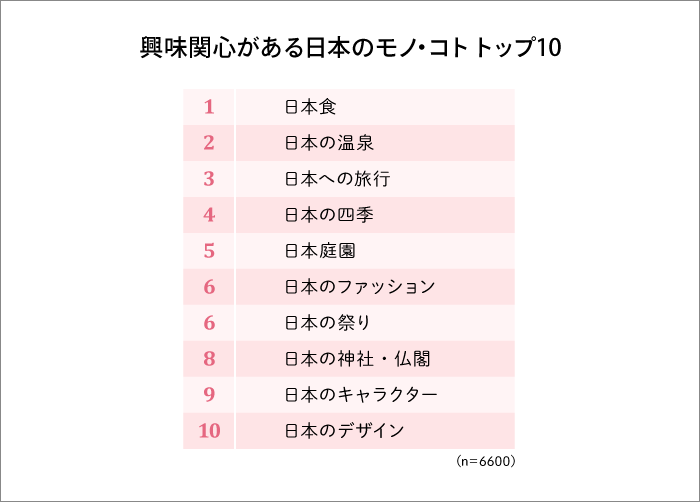
Looking at “Japanese products and experiences that spark interest,” we notice that in addition to tourist attractions like hot springs, many people cite aspects of contemporary culture, such as “Japanese fashion,” “Japanese characters,” and “Japanese design.”
“Japanese fashion,” in particular, scored highly in Asia and ranked fifth in the UK. Similarly, “Japanese design” ranked fifth in Canada, attracting interest even in countries where the intention to visit Japan or general interest in the country isn’t particularly high.
Part 3 , we mentioned that “shopping” ranked among the “Top 5 Things to Do in Japan.” However, “Japanese cuisine,” as well as “hot springs” and “the four seasons,” are also linked to “Things and Experiences in Japan That People Are Interested In.”
It seems likely that more people who appreciate Japanese fashion and design sensibilities will visit Japan, thinking, “I want to experience things I’m interested in—like hot springs—in their authentic setting, and buy the items I’m interested in right here.”
For example, it has already been reported in the news that many foreign visitors are traveling to “locations” featured in anime such as *Slam Dunk* and *Your Name* (anime and manga rank 11th among “Things and Experiences in Japan That People Are Interested In”).
Not only traditional tourist attractions but also modern Japanese culture—such as anime, manga, fashion, characters, and design—is drawing more visitors with diverse purposes. This suggests the broad potential for inbound tourism that is unique to Japan.
In Parts 3 through 5 of this series, I noted that even as the nationalities and purposes of visitors to Japan diversify, “Japanese cuisine” remains a major factor driving tourism to the country.
Moving forward, “Japan’s technological prowess”—which also underpins the high level of interest in the Osaka-Kansai World Expo—and the act of purchasing Japanese products that leverage that technological prowess and Japan’s increasingly sought-after design and aesthetic sensibilities are emerging as new factors driving visits to Japan.
In the next few installments, I’d like to delve deeper into these “Japanese products” and “Japanese cuisine.”
[Contact Information for Inquiries Regarding This Matter]
Dentsu Inc., Japan Brand Project Team
japanbrand@dentsu.co.jp
Japan Brand Research Hub Page
https://www.dentsu.co.jp/knowledge/japan_brand/
[Purpose of the Dentsu Inc. Brand Survey]
Launched in 2011—when the Great East Japan Earthquake led to reputational damage affecting Japanese agricultural and marine products as well as inbound tourism—this is Dentsu Inc.’s proprietary commercial marketing research initiative designed to understand how products and services originating in Japan are perceived globally.The Japan Brand Survey regularly assesses the perceptions and actual behaviors of overseas consumers regarding the Japan brand as a whole, covering areas such as overseas travel, inbound tourism, culture, regional revitalization, Japanese cuisine, Japanese products, and lifestyle. By visualizing shifting consumer sentiments as well as the challenges and potential of the Japan brand, the survey contributes to increasingly complex corporate activities and helps promote cross-cultural understanding within Japanese society.
[Dentsu Inc. Brand Survey 2019: Survey Overview]
・Target Areas: 20 countries and regions (Mainland China, Hong Kong, Taiwan, South Korea, India, Singapore, Thailand, Indonesia, Malaysia, Vietnam, the Philippines, Australia, the United States, Canada, the United Kingdom, France, Germany, Italy, Russia, Turkey)
・Sample Size: 6,600 (Breakdown: United States 600, Mainland China 600, other countries and regions 300 each)
・Survey Period: December 2018
・Eligibility criteria: Men and women aged 20–59 (middle-income bracket and above)
・Survey Method: Online survey
・Research Organizations: Dentsu Inc. (Principal Investigator), Video Research Ltd. (Implementation Partner)
[Notes and Disclaimers]
*1: The target areas in mainland China were primarily Tier 1 cities; in Australia, the Sydney metropolitan area; and in Southeast Asia, primarily metropolitan areas.
*2: Definition of middle-income group: Criteria were established for each country based on average national income figures (such as OECD statistics) and socio-economic classification (SEC).
*3: Samples were collected using equal allocation by gender and age group in each country and region, and the data was weighted to reflect the population distribution.
*4: Since the composition ratios in this survey are rounded to the second decimal place (or to the first decimal place where displayed as whole numbers), the total may not add up to 100%.
*5: In creating the charts and tables for this survey, the names of the countries and regions analyzed use the international standard ISO country codes (ISO 3166-1 alpha-2/3), with a few exceptions.
United States/US/USA, Canada/CA/CAN, Australia/AU/AUS, United Kingdom/UK/GBR, Germany/DE/DEU, France/FR/FRA, Italy/IT/ITA,Spain/ES/ESP, Finland/FI/FIN, United Arab Emirates/UAE, Saudi Arabia/SA/SAU, India/IN/IND, Indonesia/ID/IDN, Singapore/SG/SGP, Malaysia/MY/MYS, Philippines/PH/PHL, Thailand/TH/THA,Vietnam/VN/VNM, Mainland China/CN/CHN, Hong Kong/HK/HKG, Taiwan/TW/TWN, South Korea/KR/KOR, Turkey/TR
*6: The names of countries and regions used in this survey report and on our website are based on the Japanese government’s long-standing position, as well as Japanese social norms and business practices.
*7: The names of countries and regions used in this survey are for statistical or analytical convenience only and do not imply any political stance or opinion.
*8: The maps used in this survey (world map and map of Japan) have been partially modified and cropped to suit the analysis content and page layout; therefore, they may not necessarily reflect national borders and territorial boundaries accurately.
*9: As a commercial marketing research study aimed at understanding the lifestyle habits and brand preferences of general consumers, this survey has been conducted consistently since its inception through commissioned fieldwork partners, in strict compliance with local laws, regulations, and public order and morals.Surveys conducted in China are carried out through fieldwork contractors who have obtained the “Foreign-Related Survey Permit” required by Chinese authorities; our company does not conduct market research activities within China itself. Furthermore, we monitor and review our operational procedures as necessary in light of developments such as changes in laws and regulations.
*10: The response data collected through this survey is obtained, managed, and processed lawfully in accordance with the relevant laws and regulations of each target market. The data we receive consists solely of aggregated data that has been anonymized in a manner that does not allow for the identification of specific individuals and cannot be reversed; it does not contain any personal information.
Was this article helpful?
Share this article


Newsletter registration is here
We select and publish important news every day
For inquiries about this article
Back Numbers
Author

Katsura Nakazato
Dentsu Inc.
Fourth Marketing Bureau
Communications Director
Japan Brand Survey 2015Reflecting on Japan's Present and Future Through the 2019 Japan Brand SurveyExploring Japan's Potential Through Dentsu Inc. Japan Brand ResearchGlobal Sentiments and Japanese Identity: Japan Brand Survey 2023Global Sentiment and Japanese Identity: Japan Brand Survey 2024Insights from Overseas Residents in Their 15th Year: Japan Brand Survey 2025