Note: This website was automatically translated, so some terms or nuances may not be completely accurate.
 Exploring Japan's Potential Through Dentsu Inc. Japan Brand Research [1/3]
What’s Next for Inbound Tourism in Japan?—Overseas Travel Trends and Japan’s Rising Popularity—
The spread of the novel coronavirus temporarily imposed significant restrictions on global travel, leading to changes in lifestyles and values. Although there is still no end in sight, economic activity and travel are resuming and picking up momentum under the “living with COVID-19” approach.
How has the “Japan Brand” fared in the wake of the COVID-19 pandemic?
What kind of business opportunities are likely to emerge in the future?
By examining the latest data from Dentsu Inc.’s proprietary “Japan Brand Survey”—a major overhaul in 2022 targeting middle- and high-income consumers overseas ( see overview here )—we’ll explore the current state of the Japan brand and Japan’s future potential. In Parts 1 and 2, we’ll focus on the theme of “inbound tourism.”
Europe is already on the move, while Asia remains cautious: Regional differences in travel sentiment and overseas travel trends
According to figures released by the United Nations World Tourism Organization (UNWTO), the number of international tourists worldwide in 2021 (international tourist arrivals) increased by 4% year-over-year to 415 million. While this figure is significantly lower than the 1.461 billion recorded in 2019, the number of people who have already resumed international travel is on the rise.
In a Japan Brand Survey conducted in 2022, when respondents were asked when they planned to consider overseas travel, the most common answer was “after the COVID-19 pandemic has completely ended.” However, a significant number of respondents also indicated that they had “already begun considering countries and regions where restrictions have been lifted” or had “already resumed overseas travel.”
This response was particularly common in Europe (Data 1), and a separate analysis of search volume using Google tools also showed that European countries were among the first to see travel-related search volume recover to 2019 levels or higher, indicating a strong appetite for travel. This is likely due in large part to the fact that travel within the EU was among the first to be permitted again.
On the other hand, in Asia—particularly in East Asian countries and regions—few people are considering or actually taking overseas trips, and the score for the option “after the COVID-19 pandemic has completely ended” is significantly higher compared to Europe and the U.S., suggesting that people have not yet shifted into “overseas travel mode.” Asia accounted for about 80% of pre-pandemic visitors to Japan and remains a crucial region for Japan’s inbound tourism. The timing of the recovery in travel sentiment in Asia is likely to have a major impact on Japan’s inbound tourism going forward.
“Enjoying travel with peace of mind” is the key phrase. How have overseas travel needs changed before and after the pandemic?
So, how has the demand for overseas travel changed before and after the pandemic? Looking at the 2022 results regarding “priorities for overseas travel” while referencing the pre-pandemic findings (2018 survey) from the Japan Brand Survey, it appears that factors related to “nature” and “public safety” are now being prioritized (Data ②).
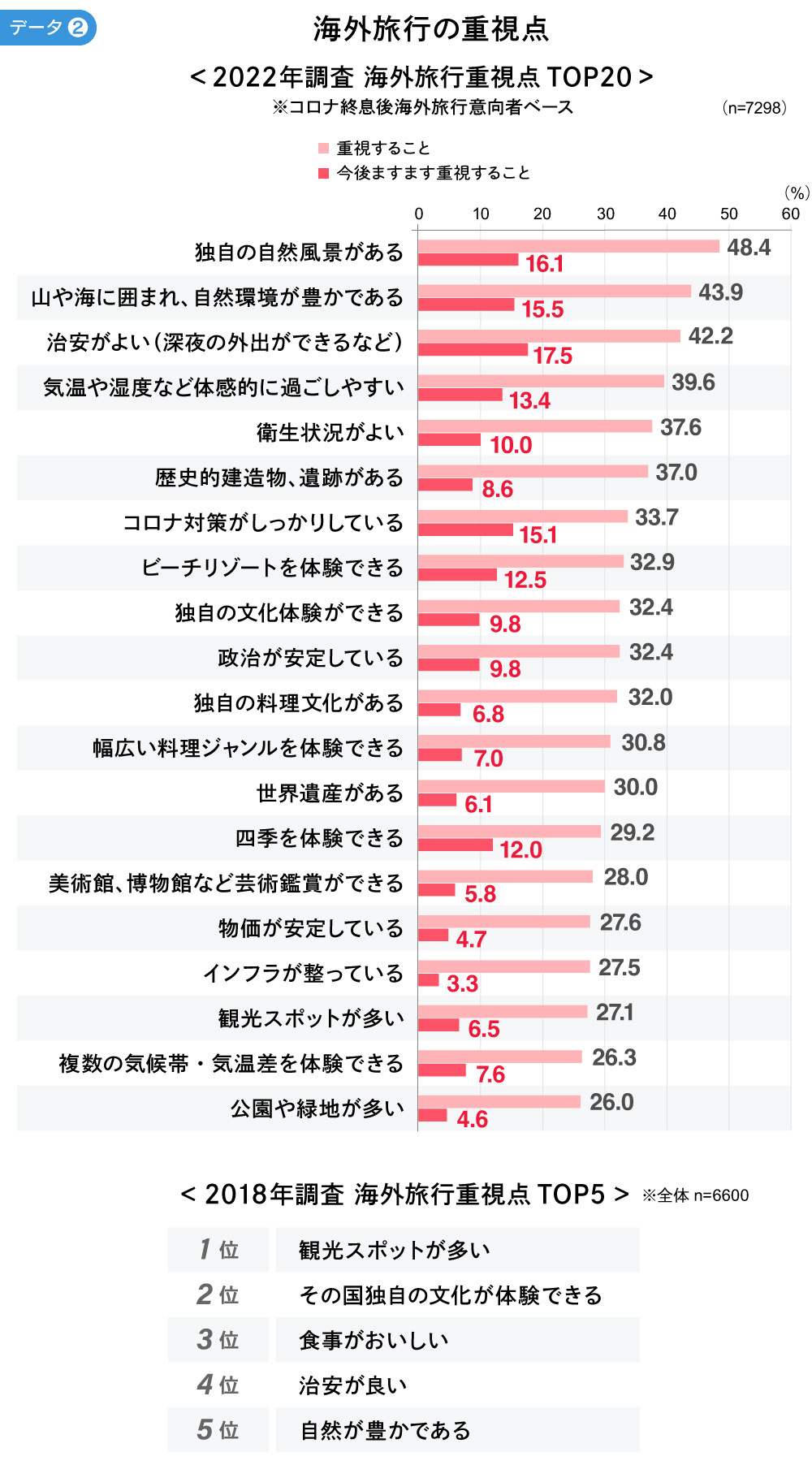
In Taiwan, in particular, “good public safety” and “good sanitary conditions” rank as the top two priorities. It appears that people in Asia tend to place a high priority on “whether they can stay with peace of mind.”
On the other hand, in Europe and the United States, nature-related items—such as “unique natural scenery,” “surrounded by mountains and the sea, with a rich natural environment,” and “comfortable temperatures and humidity levels”—occupy the top three spots. It seems travelers are drawn to trips where they can relax and take deep breaths in nature; the desire to “spend time in nature rather than in crowded city centers” may also reflect a desire for “peace of mind during their stay” stemming from the COVID-19 pandemic.
That said, this does not mean that the desire to travel has changed significantly from before the pandemic. In a Japan Brand Survey conducted in 2022, when respondents were asked about measures that would increase their desire to travel abroad, the top response was “videos showcasing the climate and natural beauty of the destination,” followed by “videos showcasing the cultural appeal of the destination” and “videos showcasing the culinary delights of the destination” (Data ③).
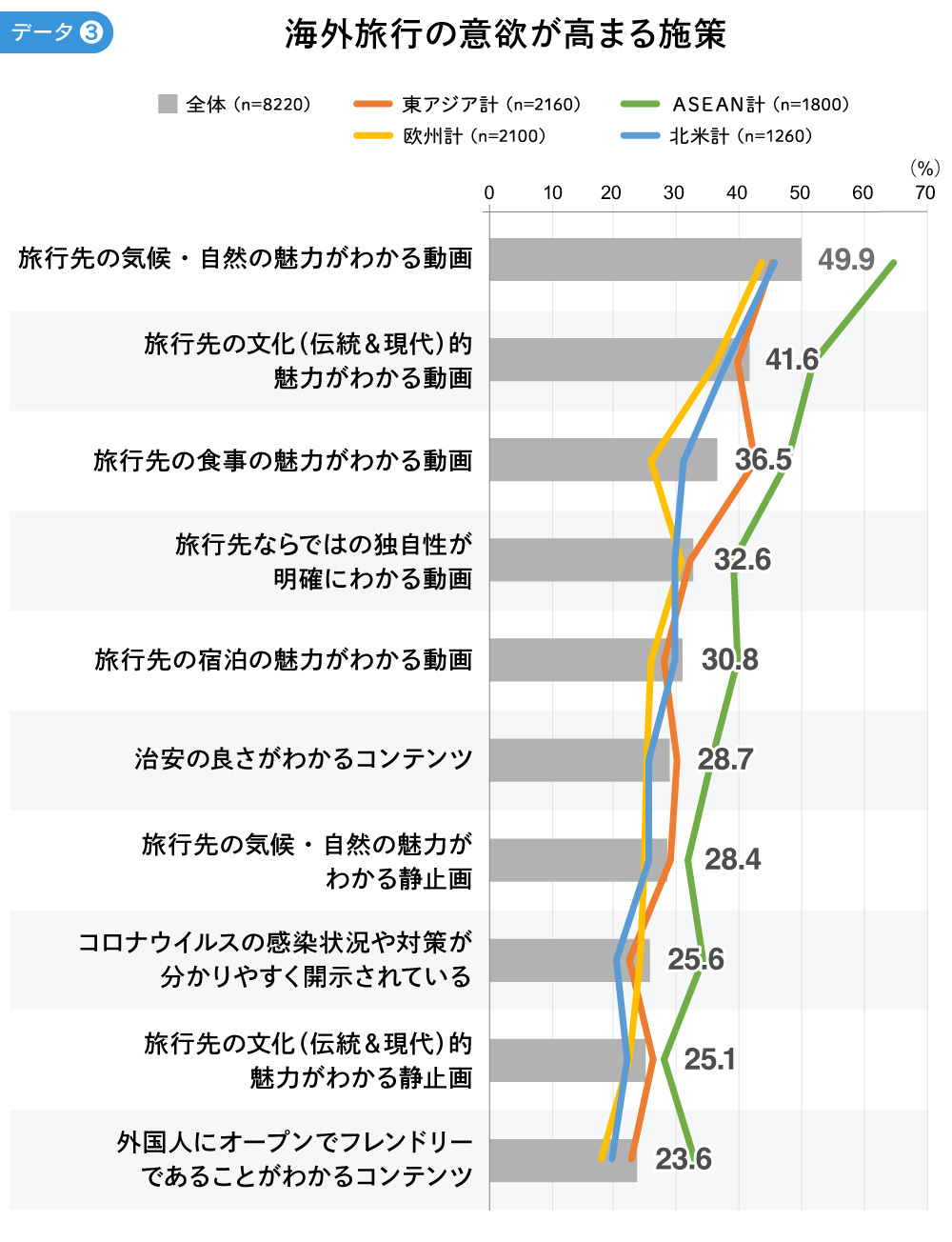
The universal desires to “experience different cultures” and “enjoy delicious food” remain as strong as ever even after the pandemic, and it seems these experiences—which were unavailable during the daily life of the pandemic—are now being sought after even more intensely.
Is Japan’s Inbound Tourism on Track? Growing Expectations for New Demographic Segments
Although I mentioned at the beginning that “Asians are not yet in the mood for overseas travel,” the results show that “Japan” has become a popular post-pandemic travel destination regardless of region.
In the “Overseas Destinations I Want to Visit” category—where respondents were presented with a list of multiple overseas destinations, including Japan, and asked to choose—“Japan” ranked overwhelmingly first. Furthermore, “Japan” topped the list in 17 out of 22 countries surveyed, and it has significantly climbed in the rankings even in countries where it did not previously feature among the top choices (Data ④).
Before the pandemic, Japan was not a particularly popular travel destination in Western countries. Its popularity as a travel destination may be on the rise as part of a “revenge spending” trend—a reaction to the desire to break free from the stifling restrictions of life during the pandemic and visit places people have never been to or that offer a more extraordinary experience. This trend is likely being driven by Japan’s natural beauty—including its coastal locations and four distinct seasons—as well as its long-standing reputation for safety and hygiene.
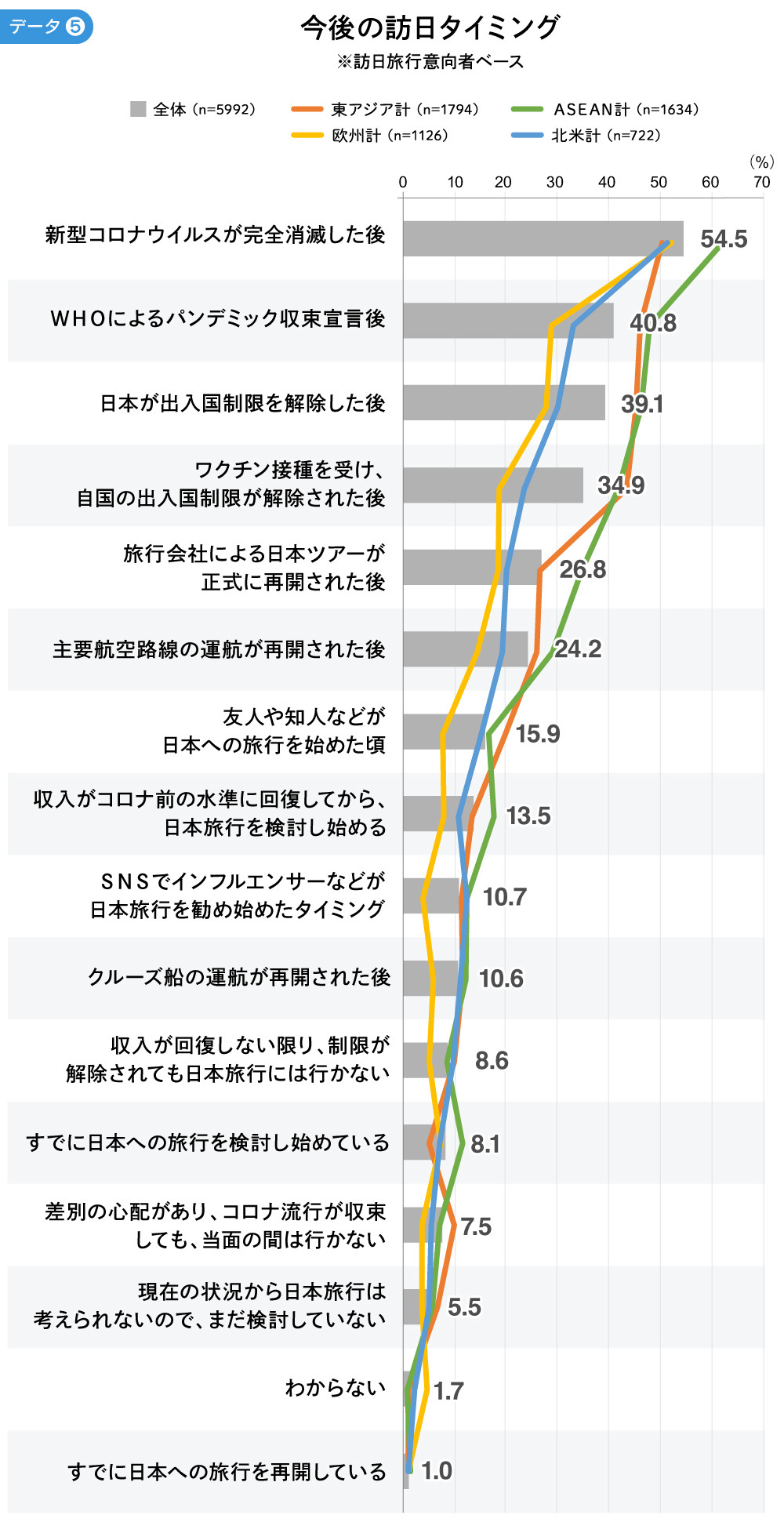
So, as restrictions in Japan are gradually eased, when will tourists begin returning? When asked about their preferred timing for future visits to Japan, “after the novel coronavirus has been completely eradicated” and “after the WHO declares the pandemic over” were the top two responses; however, these seem to represent ideal scenarios rather than realistic expectations (Data ⑤).
In reality, what factors will prompt people to travel to Japan?
The response with the third-highest score, following the top two, is “after Japan lifts its entry and exit restrictions.” With restrictions still in place in many countries and regions, it appears there is a growing trend of people thinking, “Let’s go where we can go and where it’s easy to go,” suggesting that further easing of restrictions in Japan will be a crucial turning point.
Furthermore, in ASEAN, factors such as “after travel agencies officially resume tours to Japan” and “after major airline routes resume operations”—in other words, the establishment of practical means of travel—are becoming increasingly important.
In East Asia, where the desire to travel has been slow to return, there is also a slight tendency for people to wait until others actually start traveling—for example, “when friends or acquaintances begin traveling to Japan.”
Taking all of the above into account, it is predicted that once Japan fully eases restrictions, the first group to act will be those in Europe and the U.S.—where enthusiasm for overseas travel is high—followed by ASEAN, and finally East Asia, which will wait to see how things develop. Of course, this depends on how the COVID-19 situation unfolds going forward, and while Asia remains a crucial target market as the main source of inbound tourists to Japan, it is certain that opportunities are emerging to attract new customer segments.
In this article, we’ve highlighted how, in the “living with COVID-19” era, people are beginning to travel again despite regional differences, and as demand for overseas travel shifts in some areas, Japan is gaining attention as an attractive travel destination. So, what steps should be taken to capitalize on this opportunity and actually bring foreign tourists to Japan? In our next article, we’ll discuss tips for recovering and expanding Japan’s inbound tourism.
[Contact Information for Inquiries Regarding This Matter]
Dentsu Inc., Japan Brand Project Team
japanbrand@dentsu.co.jp
Japan Brand Research Hub Page
https://www.dentsu.co.jp/knowledge/japan_brand/
[Purpose of the Dentsu Inc. Brand Survey]
Launched in 2011—when the Great East Japan Earthquake led to reputational damage affecting Japanese agricultural and marine products as well as inbound tourism—this is Dentsu Inc.’s proprietary commercial marketing research initiative designed to understand how products and services originating in Japan are perceived globally.The Japan Brand Survey regularly assesses overseas consumers’ perceptions and actual behaviors regarding the Japan brand as a whole, covering areas such as overseas travel, inbound tourism, culture, regional revitalization, Japanese cuisine, Japanese products, and lifestyle. By visualizing shifting consumer sentiments and the challenges and potential of the Japan brand, the survey contributes to increasingly complex corporate activities while also promoting cross-cultural understanding within Japanese society.
[Dentsu Inc. Brand Survey 2022: Survey Overview]
・Target Areas: 22 countries and regions (United States, Canada, Mainland China, South Korea, Taiwan, Hong Kong, Singapore, Thailand, Malaysia, Indonesia, Vietnam, the Philippines, India, Australia, Saudi Arabia, the United Kingdom, France, Germany, Italy, Spain, Russia, Finland)
・Sample Size: 8,220 (Breakdown: United States 960, Mainland China 1,260, Other Countries and Regions 300 each)
・Survey Period: December 2021–January 2022
・Eligibility criteria: Men and women aged 20–59 (middle-income bracket and above)
・Survey Method: Online survey
・Research Organizations: Dentsu Inc. (commissioner), Video Research Ltd. (implementation partner)
[Notes and Disclaimers]
*1: The target areas in mainland China are primarily Tier 1 cities; in India, they are Delhi and Mumbai; in Australia, the Sydney metropolitan area; and in Southeast Asia, they are primarily metropolitan areas.
*2: Definition of middle-income group: Criteria were established for each country based on average national income figures (such as OECD statistics) and socio-economic classification (SEC).
*3: Samples were collected using equal allocation by gender and age group in each country and region, and the data was weighted to reflect the population distribution.
*4: Since the composition ratios in this survey are rounded to the second decimal place (or to the first decimal place where displayed as whole numbers), the totals may not add up to 100%.
*5: In creating the charts and tables for this survey, the names of the countries and regions analyzed use the international standard ISO country codes (ISO 3166-1 alpha-2/3), with a few exceptions.
United States/US/USA, Canada/CA/CAN, Australia/AU/AUS, United Kingdom/UK/GBR, Germany/DE/DEU, France/FR/FRA, Italy/IT/ITA,Spain/ES/ESP, Finland/FI/FIN, United Arab Emirates/UAE, Saudi Arabia/SA/SAU, India/IN/IND, Indonesia/ID/IDN, Singapore/SG/SGP, Malaysia/MY/MYS, Philippines/PH/PHL, Thailand/TH/THA,Vietnam/VN/VNM, Mainland China/CN/CHN, Hong Kong/HK/HKG, Taiwan/TW/TWN, South Korea/KR/KOR
*6: The names of countries and regions used in this survey report and on our website are based on the Japanese government’s long-standing position, as well as Japanese social norms and business practices.
*7: The names of countries and regions used in this survey are for statistical or analytical convenience only and do not imply any political stance or opinion.
*8: The maps used in this survey (world map and map of Japan) have been partially modified and cropped to suit the analysis content and page layout; therefore, they may not necessarily reflect national borders and territorial boundaries accurately.
*9: As a commercial marketing research study aimed at understanding the lifestyle habits and brand preferences of general consumers, this survey has been conducted consistently since its inception through commissioned fieldwork partners, in strict compliance with local laws, regulations, and public order and morals.Surveys conducted in China are carried out through fieldwork contractors who have obtained the “Foreign-Related Survey Permit” required by Chinese authorities; our company does not conduct market research activities within China itself. Furthermore, we monitor and review our operational procedures as necessary in light of developments such as changes in laws and regulations.
*10: The response data collected through this survey is obtained, managed, and processed lawfully in accordance with the relevant laws and regulations of each target market. The data we receive consists solely of aggregated data that has been anonymized in a manner that does not allow for the identification of specific individuals and cannot be reversed; it does not contain any personal information.
Was this article helpful?
Share this article


Newsletter registration is here
We select and publish important news every day
For inquiries about this article
Author

Katsura Nakazato
Dentsu Inc.
Fourth Marketing Bureau
Communications Director
Japan Brand Survey 2015Reflecting on Japan's Present and Future Through the 2019 Japan Brand SurveyExploring Japan's Potential Through Dentsu Inc. Japan Brand ResearchGlobal Sentiments and Japanese Identity: Japan Brand Survey 2023Global Sentiment and Japanese Identity: Japan Brand Survey 2024Insights from Overseas Residents in Their 15th Year: Japan Brand Survey 2025