Note: This website was automatically translated, so some terms or nuances may not be completely accurate.
 The future seen from the perspective of young people, just half a step ahead [6/7]
From consuming “results” to co-creating “processes”: The “craft-based” form of sports led by Gen Z
Dentsu Inc.’s Youth Research Division (hereinafter referred to as “Dentsu Wakamon”) held a “Tsugikuru” workshop with Gen Z students. Under the theme “The Future Shape of [X],” the workshop involves developing hypotheses based on reports submitted by college students ( click here for the article on the “Tsugikuru” workshop).
The theme of this installment is “The Future of ‘Sports’ as Envisioned by Gen Z Students.” As sports continue to evolve through technology, including AI, we explore how young people’s attitudes toward sports are changing.
Dentsu Inc. Youth Research Division “Wakamons”
A specialized division within Dentsu Inc. that continuously researches the attitudes, values, and behaviors of young people, covering areas ranging from marketing and business development to organizational and human resources. Rather than viewing young people solely through the lens of generational theory, the division redefines them as “people who act based on new values.” By interpreting these values as “signs of the future,” it supports companies and society in charting their next course.
Gen Z Values “Process and Fluctuation” Just as Much as Results
Until now, the sports business has been dominated by a “one-dimensional game” model—where the viewing experience is packaged by the organizer, as exemplified by watching professional baseball games in the past—and a “mass-product” model that unilaterally delivers the “win or loss (result)” to fans. However, the sports outlook of Gen Z—who actively seek out information and find meaning not only in results but also in the process and context—is taking on a slightly different form.
To understand the current state of sports among young people, we conducted a survey of college students nationwide using “CircleApp,” a communication app dedicated to university clubs, and uncovered some interesting trends.
While “the result itself” (42.5%) still received the most votes as the most appealing aspect, it is noteworthy that nearly the same proportion of young people are also drawn to “the intricacies of the play (detailed tactics and split-second decisions)” (41.0%). Additionally, about 30% cited “the background story.”This shows that watching sports is evolving from simply “checking the outcome” to an “experience where viewers actively focus on and enjoy diverse aspects of the game,” such as tactics and the stories behind the players and matches.
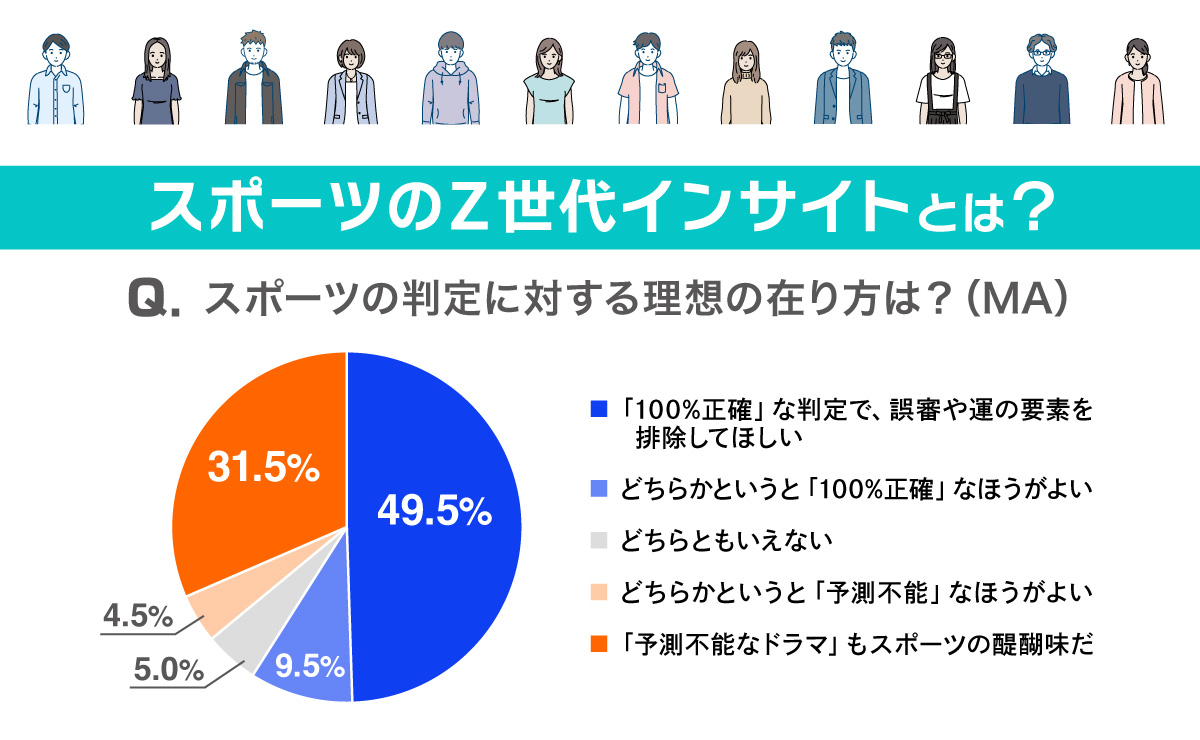
Rational voices supporting AI officiating—those who believe it “should be 100% accurate” or “should be somewhat accurate”—accounted for just under 60%. On the other hand, however, slightly more than 30% of young people responded that “the inconsistencies and drama created by human referees are part of the thrill.”Among the digital native generation, for whom efficiency and accuracy are taken for granted, the existence of such a large group that deliberately seeks “unpredictable uncertainty” and “human-like leeway” in sports is a very interesting sign.
What emerges from these survey results is a transitional phase in which sports for Gen Z are shifting from something passively consumed as a given outcome to something that viewers themselves choose “where to place value” and reinterpret.
We have named this new trend in sports—where consumers themselves find meaning from their own unique perspectives and, at times, even reshape the form of sports to fit their communities—the shift toward a “craft-based” model.
Research Organization: Dentsu Inc.; Survey Participants: 200 undergraduate and graduate students nationwide; Survey Period: May 2026. *Percentage figures are rounded to the second decimal place, so the total may not always add up to 100%.
Three Changes Toward the “Craft-Style” Model Revealed in Student Reports
A closer look at the reports titled “The Future Shape of Sports” submitted by students during the workshop reveals that this shift toward the “Craft-Type” manifests in three major ways.
① Crafting “Immersion Points”: Discovery-Based Cheering and Story Sharing
Thanks to advances in AI and tracking data, modern sports have become fully visualized down to the finest details of gameplay. Some student reports referred to this as “discovery-based support.” Fans no longer simply watch pre-selected highlights; instead, they use data to discover athletes’ hidden charms on their own, leading to deeper immersion.
Furthermore, as pointed out in another report regarding “star development programs,” there is a growing tendency for fans to find value in empathizing with the “behind-the-scenes” stories—such as athletes’ efforts and struggles—and witnessing their growth process firsthand, much like watching a talent show. Additionally, a viewing style is becoming established where fans watch the game on a large TV screen while simultaneously enjoying their “favorite player’s” reactions via a vertical-screen live stream on their smartphones. They are actively seeking out points of immersion beyond the game itself.
② The Art of “Uncertainty (Fluctuation)”: A Counter to AI Refereeing
As the digitization of sports data and AI-based decision-making advance, a backlash is emerging against sports becoming “too correct.” A report titled “The More the AI Whistle Blows, the Louder the Human Voice Resonates” pointed out that while AI ensures fairness, the value of “human-like leeway”—such as errors and fluctuations—is increasing.
On social media, umpires’ strike-calling accuracy rates are being compared as data, and behind-the-scenes judgments have become the subject of debate to the point where people are asking, “Are the umpires the stars!?” This is not merely criticism; rather, it can be seen as a manifestation of “craft” behavior—an attempt to savor the “unpredictable drama (uncertainty)” created by human hesitation and luck as the true thrill of sports.
③ The Craft of “Rules and Society”: The Era of Proliferation in National Sports
There is also a notable trend of people rewriting the rules themselves rather than simply accepting them as given. Some reports have pointed out the limitations of modern sports becoming too “predictable” due to data and suggest that we are entering a “period of fragmentation in the ‘nation of sports’” where new orders are being established.
A symbol of this trend is the “Kings League,” founded by former professional soccer player Gerard Piqué.By deliberately incorporating variability and chance into the rules—such as rolling dice to reduce the number of players or using special cards to double scores—it is generating new excitement among people who have grown tired of the existing framework. Re-crafting the very form of sports to align with their own communities and values—this is the future of sports.
From “Finished Products” to “Co-Creation Platforms”
In the coming era, when companies and brands engage with sports, simply sponsoring “one-dimensional excitement (mass-produced products)” will no longer resonate with young people. What’s needed is a perspective that offers and supports sports as a “co-creation platform with room for interpretation”—one where consumers themselves can discover the process, enjoy uncertainty, and reinterpret the rules in their own way.
For example, this could involve making the data behind the scenes of a game open source to encourage fans to conduct their own analyses (craft), or using technology to deliberately create new viewing experiences that incorporate “serendipity.” The shift toward a “craft-based” approach to sports may be an instinctive movement, allowing young people to rediscover tangible “excitement and play” in a modern society dominated by logic and efficiency.
Was this article helpful?
Share this article


Newsletter registration is here
We select and publish important news every day
For inquiries about this article
Back Numbers

Author

Takumi Ohtori
Dentsu Inc.
Marketing Division 2
Marketing Consultant