Note: This website was automatically translated, so some terms or nuances may not be completely accurate.
 Information Media White Paper Special Report 2026: “The Current State of Evolving Information Trends” [2/3]
Generative AI and Video Are Radically Transforming “Learning” — Media Becomes a Partner in People’s Lives —
For the past 32 years, the “Information Media White Paper” has been published in book form. With the understanding and cooperation of the relevant companies and organizations, we have now released it on the Dentsu Inc. website as the “Information Media White Paper 2026,” with the aim of contributing to the broader development of the media industry.
In this series, based on research and studies conducted by the Dentsu Inc. Media Innovation Lab, we will explain changes in the media environment and trends in the advertising market as part of a special feature report from the “Information Media White Paper 2026.”
In this second installment, we take a broad view of “learning”—encompassing hobbies and daily life—and present the results of our original survey ( see here for survey overview ) designed to understand the reality of “learning” through diversifying tools and services, including generative AI. So Hasegawa of the Dentsu Inc. Media Innovation Lab examines attitudes toward learning and knowledge acquisition, actual usage patterns and evaluations of various tools and media, and offers insights for reaching business professionals.
<Table of Contents>
▼The “Information Explosion” Predicted in the Mid-Showa Era Has Become a Reality
▼Attitudes and Motivation Toward Information Intake in the Reiwa Era
▼The Content of “Learning” and the Reality of Its Use
▼The Surprising Penetration of Video-Sharing Services
▼How to Reach Business Professionals
▼Media is shifting toward a “supportive” role. Discussions on the expansion of “learning” and digital education
The “information explosion” predicted in the mid-Showa era has become a reality
and the landscape surrounding learning is undergoing significant changes. I feel that traditional learning was fundamentally based on an active engagement with books and other materials, where thoroughly reading the text was essential for establishing a solid foundation of systematic knowledge. My generation’s education from childhood was also based on this premise; there was a great deal of opposition to “learning while doing other things,” and looking back now, I have the impression that our education carried a somewhat idealistic element.
In the practical guide*The Complete Guide to Output: Turning Learning into Results* (Sanctuary Publishing, 2018) and *The Complete Guide to Input: Maximizing Learning Efficiency* (Sanctuary Publishing, 2019), written by psychiatrist Shion Kabasawa, garnered significant attention by introducing brain-science-based methods for communication, writing, studying, and information gathering—all amid a growing diversity of learning options. It seemed to make visible the fact that efficiency is now sought even in the realm of learning.
In the 1960s, philosopher and cultural critic Tadao Umesao (1920–2010), observing the growing flood of books, foresaw what would later be called the “information explosion.”In his book *The Techniques of Intellectual Production* (Iwanami Shoten, 1969), he noted that in the face of ever-increasing information, “searching, processing, producing, and disseminating” were essential foundational skills. How would Umesao assess this world, where the information environment has undergone such a drastic transformation—from books to television, the Internet, and now generative AI?
Today, video-sharing sites are overflowing with a vast and diverse array of information. There are numerous videos that solve everyday problems, ranging from makeup tutorials and cooking methods—such as how to fillet fish—to practical life hacks. Furthermore, at the 2012 London Olympics, javelin thrower Keshon Walcott (Trinidad and Tobago) stunned the world by winning a gold medal after practicing by watching YouTube videos.
While it depends on the field, this example suggests the possibility of achieving a high level of “mastery” simply by imitating movements, without needing a systematic understanding. Although there are some concerns about the reliability of the information, it can be said that the rapid proliferation of video-sharing sites is significantly changing the methods and concepts of “learning” in a broad sense.
ChatGPT, a generative AI released by OpenAI in November 2022, has expanded rapidly—reaching 100 million users worldwide within two months of its launch—and is fundamentally transforming the nature of intellectual work around the globe. While various concerns have been raised, it is now being praised not only for its convenience but also for its user-friendly approach. As its functions and accuracy continue to advance and its points of contact expand, there is no doubt that it will become even more deeply integrated into people’s lives in the future.
Reiwa-Era Attitudes and Motivation Toward Input
Figure 01 shows a partial excerpt of the results from a survey asking Reiwa-era consumers about their attitudes toward “learning” and information intake (with respondents rating how well four categories applied to them). The findings reveal that many consumers prefer efficient and immediate information intake—such as wanting answers right away, not wanting to spend time or money, and prioritizing “time efficiency” in their information consumption.
It is believed that this trend is accelerated by an environment where people can easily and quickly access answers and hints anytime, anywhere through smartphones and video-sharing sites. Some observers point out that, depending on one’s perspective, this constitutes a “piecemeal” approach to gathering information, and that it makes it difficult to acquire systematic knowledge.On the other hand, there is a strong desire for clear thinking and expertise, as well as a desire to use learning to express one’s individuality; in fact, more than half of respondents expressed a desire to acquire knowledge thoroughly.
Furthermore, amid a flood of choices and information, some consumers feel a sense of urgency regarding input and skill development, or even experience “knowledge obesity.” It can be said that, within today’s media environment, there are also some negative psychological aspects associated with “learning.”
Figure 02 summarizes the results of a cluster analysis conducted on the responses to the aforementioned questions (a total of 14 items across 4 categories, N=2,000). Based on this, Figure 03 (left) shows the cluster distribution by gender and age group. For both men and women, the “Practical and Active Group” in their 20s accounts for over 30%—the largest proportion—indicating that younger people have a higher motivation for proactive learning.On the other hand, the proportion of the “Practical and Active Group” decreases as age increases. In particular, among men in their 40s and older and women in their 30s and older, the “Steady and Self-Paced Learners,” who prefer to gather information at a steady pace, increase to around 40 percent. Furthermore, among middle-aged and older adults—especially women in their 50s and 60s—the “Passive and Casual Group” accounts for nearly 40 percent.
In this survey, we provided examples of a total of 14 tools, services, and media (hereinafter referred to as “tools”), including paper books, videos (free/paid), and generative AI (free/paid), and asked respondents whether they used any of them for the purpose of “learning” in a broad sense (such as acquiring knowledge, self-improvement, taking lessons, or gaining practical life skills), excluding those provided by their employers.The overall adoption rate for “learning”—defined as the use of any of these tools for learning purposes—stood at 52.8%.
Figure 03 (right) shows the participation rates by gender and age group. Notably, men in their 20s had the highest rate at 61.1%; this suggests that, as they are in the early stages of their careers, a strong desire for self-investment is driving their behavior.On the other hand, participation rates among women dropped in their 30s (42.2%) and 50s (39.2%), suggesting that, compared to men, they are more significantly influenced by life stages. This suggests that changes in life stages, such as child-rearing and caregiving, may serve as barriers to “learning” for women.
In their 60s, participation rates rise again for both men and women; it is likely that the increase in disposable time resulting from retirement and other factors leads them to return to continuing education (where working adults relearn as needed) or “learning” for leisure. While both men and women exhibit what could be called a “W-shaped curve of learning” across generations, the circumstances surrounding “learning” are thought to be influenced not only by the information environment in which they were raised but also by changes in life stages and the resulting changes in disposable time.
Although not shown in the chart, the top five learning tools are as follows:
1st Place: Videos (Free) (34.2%)
2nd: Print books (18.9%)
3rd: News apps (14.9%)
4th: Generative AI (free) (13.3%)
5th: Newspapers (including digital) (11.7%)
While the trends are similar across nearly all age groups, there are differences by generation regarding generative AI (free), which scored particularly high among those in their 20s (men: 25.9%, women: 22.4%), ranking second for both men and women.
The Nature of “Learning” and Real-World Usage
So, what exactly does “learning” entail? Figure 04 illustrates its contents. Among the broadly defined categories of “learning,” the most common category was “Hobbies and Enriching Daily Life” (66.1%).
While many items related to so-called traditional “learning”—such as work, career, school studies, and general knowledge—appeared frequently, a significant number of items closely tied to daily life—such as housework, child-rearing, and caregiving—as well as information on health and investing also appeared. This suggests an underlying trend toward seeking to improve quality of life (QOL) in a broader sense.
Although the quality of information varies widely, an environment is taking shape where people can access information tailored to their individual circumstances and preferences at any time, even as the volume of information explodes. Against this backdrop, as mentioned earlier, it can be said that people are engaging in various forms of “learning” to enhance their careers and quality of life, in accordance with their respective life stages.
While there are numerous tools available for “learning” these days, what criteria do users use to evaluate and select them? We asked users of each tool to identify the “key factors they prioritize when using the tool.” Figure 05 presents the results of a correspondence analysis conducted on these responses.
The horizontal axis represents “Reliability ⇔ Timeliness,” while the vertical axis represents “Enjoyment ⇔ Practicality.” In particular, printed books are highly valued for their reliability and practicality, and they enjoy enduring support as tools for gaining systematic and in-depth understanding.In contrast, videos (free) and language learning apps (free) in the upper-left quadrant are valued for their enjoyment and immediacy; they are also characterized by a broad accessibility, such as being easily used during spare moments.
The tools available for “learning” are diverse. There are various evaluation criteria for “learning”—not only content but also usage scenarios, enjoyment, and the perceived effectiveness—and users select tools based on their own characteristics and objectives. Note that while questions regarding videos, generative AI, and language learning apps were asked separately for both free and paid versions, in each case, the paid versions shift toward the “reliability” and “practicality” axes compared to their free counterparts, suggesting that users are willing to pay for these specific qualities.
The Surprising Penetration of Video-Sharing Services
As mentioned earlier, videos (free) are the most widely used tools for “learning,” and among these, video-sharing services are particularly widely utilized, largely due to the vast and diverse range of content available.
Figure 06 shows the survey results regarding “what users can do or have done through the use of video-sharing services such as YouTube, TikTok, and Instagram Reels.” This article presents an excerpt showing the results for men and women in their 20s and 60s.
Could it be said that the primary purpose of “learning” for those in their 20s is self-investment and self-expression? For men, “strength training and exercise (24.1%)” ranked first, followed by “investing and money management (15.4%)” in second place, indicating a high level of interest in self-investment—including building physical strength and accumulating assets—with an eye toward the future.On the other hand, for women, “Makeup and Hair Styling (40.4%)” and “Skincare (36.5%)” ranked first and second, respectively, with “Dieting (20.5%)” coming in third, indicating a strong demand for practical beauty-related needs.
For those in their 60s, the primary goals can be described as solving daily life challenges and pursuing hobbies. For men, the top choice was “Operating and troubleshooting home appliances, PCs, etc. (28.6%),” a trend that differs significantly from that of men in their 20s.It is also interesting to note that “maintenance of cars, motorcycles, etc.” ranks high among those in their 60s, whereas it does not appear in the top rankings for those in their 20s. Meanwhile, among women, “cooking recipes and how to use kitchen appliances (41.6%)” took first place; overall, these platforms are used as sources of information to improve and make daily life more convenient. Additionally, content related to health and hobbies—such as “home gardening” and “yoga”—also ranks highly.
This shows that video-sharing services function not merely as entertainment, but also as practical tools for “learning” and gaining “life hacks.” While those in their 20s primarily aim to stay up-to-date, and those in their 60s focus on maintaining quality of life and improving convenience, it is evident that users are selecting content from the vast library based on their individual life stages and personal interests, thereby integrating these services into their daily lives. Looking across all generations, the results resemble the genre preferences typically found in magazines.
To Reach Business Professionals
So far, we have described the reality of the widespread adoption of “learning” in a broad sense, but what about the tools people use to gather daily work-related information?
Chart 07 shows the usage rates of various tools among employed individuals for gathering “work-related” information. Across all age groups, television programs ranked first. Although not shown in the chart, the highest usage rate was among men in their 60s (62.7%), while the lowest was among men in their 20s (21.0%).From a work perspective, television allows people to stay informed about current events while valuing its reliability. This indicates that television programs—which are integrated into viewers’ daily routines—are widely regarded as a valuable information-gathering tool. Additionally, among those in their 30s and older, news apps rank second only to television programs, demonstrating their widespread adoption among middle-aged and older adults. In contrast, among younger adults in their 20s and 30s, the use of X (formerly Twitter) and YouTube by celebrities was particularly high.
The average number of responses is listed at the bottom of the chart. The younger the demographic, the fewer responses they provided compared to middle-aged and older adults.It can be said that younger people gather information from a relatively small number of sources, including experts and YouTubers who align with their personal interests. In contrast, middle-aged and older adults appear to gather information from a variety of sources, including mass media. These differences are thought to be largely influenced by the information environments in which they were raised, and it can be inferred that as future generations come of age, the trends currently observed among younger people will become more widespread.
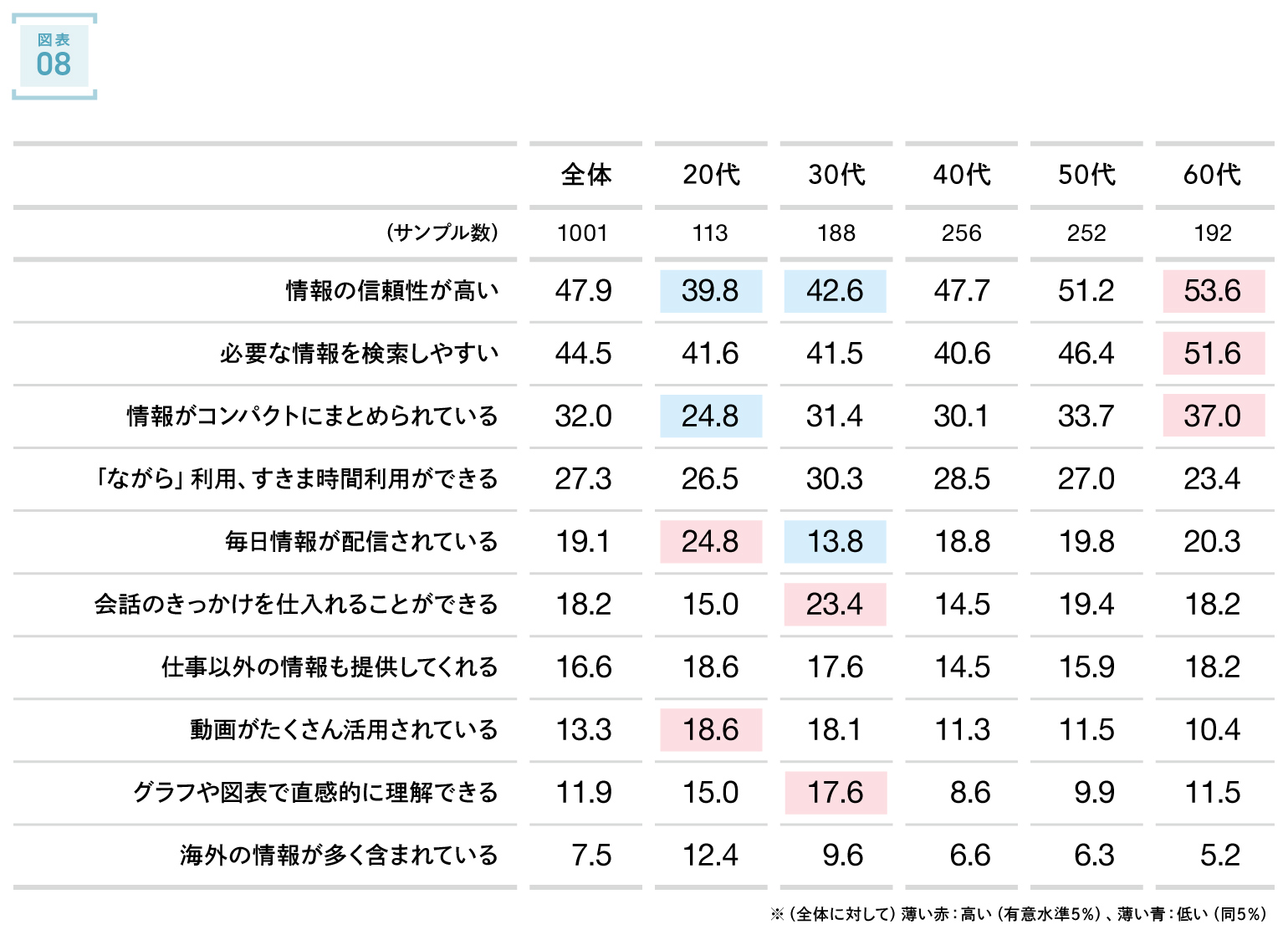
Figure 08 shows the factors respondents prioritize when gathering information for work (multiple responses allowed). The top-ranked criteria were reliability (47.9%), searchability (44.5%), and conciseness (32.0%). When broken down by generation, those in their 60s demonstrate a strong emphasis on the “quality” and “efficiency” of information.While it is understandable that they prioritize the reliability of information—as evidenced by their high rate of mass media consumption—it can also be inferred that, given they consult numerous sources, they place importance on search convenience and the conciseness of information.
On the other hand, among those in their 20s and 30s, a preference for videos, graphs, and charts is evident. Compared to middle-aged and older adults, this group appears to prefer understanding information visually and intuitively rather than by reading through text. Additionally, among those in their 30s, the use of media to find conversation starters is common, and the rates for “multitasking” and “using spare moments” are high. It is thought that changes in life stages—such as the need for communication within new communities and a reduction in disposable time—may be influencing these trends.
Media is shifting toward a “supportive” role: Expanding “learning” and the debate surrounding digital education
As discussed above, it can be argued that “learning” in the Reiwa era is no longer limited to traditional study and the accumulation of knowledge. Media has expanded beyond its role as a mere tool for consumers to gather information to keep themselves updated; it has become a tool for making daily life more convenient and improving quality of life.
In this era of information explosion, “learning” is nothing less than curating one’s own life and enhancing its quality. With video-sharing sites evolving beyond entertainment to become part of daily life’s infrastructure, and generative AI moving beyond search to serve as a thinking aid, what is required of media and services is, perhaps, a comfortable, supportive role that walks alongside users.This makes even more sense when you picture a smartphone that seamlessly delivers information on work, investments, and your favorite idols, and allows you to instantly search for answers using generative AI whenever you have a question.
When it comes to activities with a clear goal—such as preparing for entrance exams or studying for professional certifications—finding a learning method that suits you is certainly valuable today. At the same time, this does not negate the importance of traditional, systematic intellectual pursuits aimed at deep understanding, even if they are sometimes arduous.Regarding the decline in academic performance in Finland—a nation renowned for its education system—the government reportedly attributes the cause to the rapid proliferation of digital learning materials and is taking steps to address the issue. Amid increasingly complex social conditions, it is clear that having a systematic perspective based on accurate information is essential for grappling with questions that have no single answer. Furthermore, it goes without saying that—especially with free services—it is crucial to consider the context behind the vast amount of information displayed before us and how its reliability is ensured.
In his book *The Technique of Intellectual Production*, Mr. Umesao—whom I mentioned at the beginning—drew a parallel between reading and eating. With the abundance of books flooding the market at the time in mind, he emphasized the importance of high-quality, balanced reading. When it comes to the various types of information for “learning” that are increasingly influencing all aspects of our lives, surely we have much to learn from the importance of a balanced diet and the principle that we should consume foods suited to our stage of growth and physical constitution.
Rather than simply passively consuming the flood of information, it is the accumulation of our active, deliberate choices that constitutes the true “learning” necessary to thrive in the coming era and shape a fulfilling life.
[Survey Overview]
Dentsu Inc. Media Innovation Lab “Survey on Learning in the Reiwa Era”
・Nationwide online survey
・Target Population: Ages 20–69 (Valid Sample Size: 2,000)
・Survey Period: October 2025
【References】
・ Walcott, Who Became an Olympic Champion by Learning on YouTube
Was this article helpful?
Share this article


Newsletter registration is here
We select and publish important news every day
For inquiries about this article

Author

Hasegawa So
Dentsu Inc.
Dentsu Inc. Media Innovation Lab
Director of Media Innovation Research
Special Discussion: "Japan's Advertising Expenditures"Information Media White Paper 2023: What You Need to Know Now—The Past, Present, and Future of Media and SocietyInformation Media White Paper 2024: The Rapidly Changing Media Environment and Consumers100 years since its birth. Radio, today...Information Media White Paper 2025: New Horizons in Communication Shaping the FutureInformation Media White Paper Special Report 2026: “The Current State of Evolving Information Trends”


dentsu Media Innovation Lab
Dentsu Inc.
Insight MemoSpecial Discussion: "Japan's Advertising Expenditures"Explore the Amazing World of YouTube Creators with UUUMInformation Media White Paper 2024: The Rapidly Changing Media Environment and Consumers100 years since its birth. Radio, today...College Students and the Future of Media, Communication, and Advertising in Ten YearsInformation Media White Paper 2025: New Horizons in Communication Shaping the FutureInformation Media White Paper Special Report 2026: “The Current State of Evolving Information Trends”