How can Dentsu Inc.’s creative team contribute to the ever-evolving field of CX (Customer Experience)? “Monthly CX” is a series of articles written by members of Dentsu Inc.’s dedicated CX division, the “CXCC” (Customer Experience Creative Center) ( click here for more on Monthly CX).
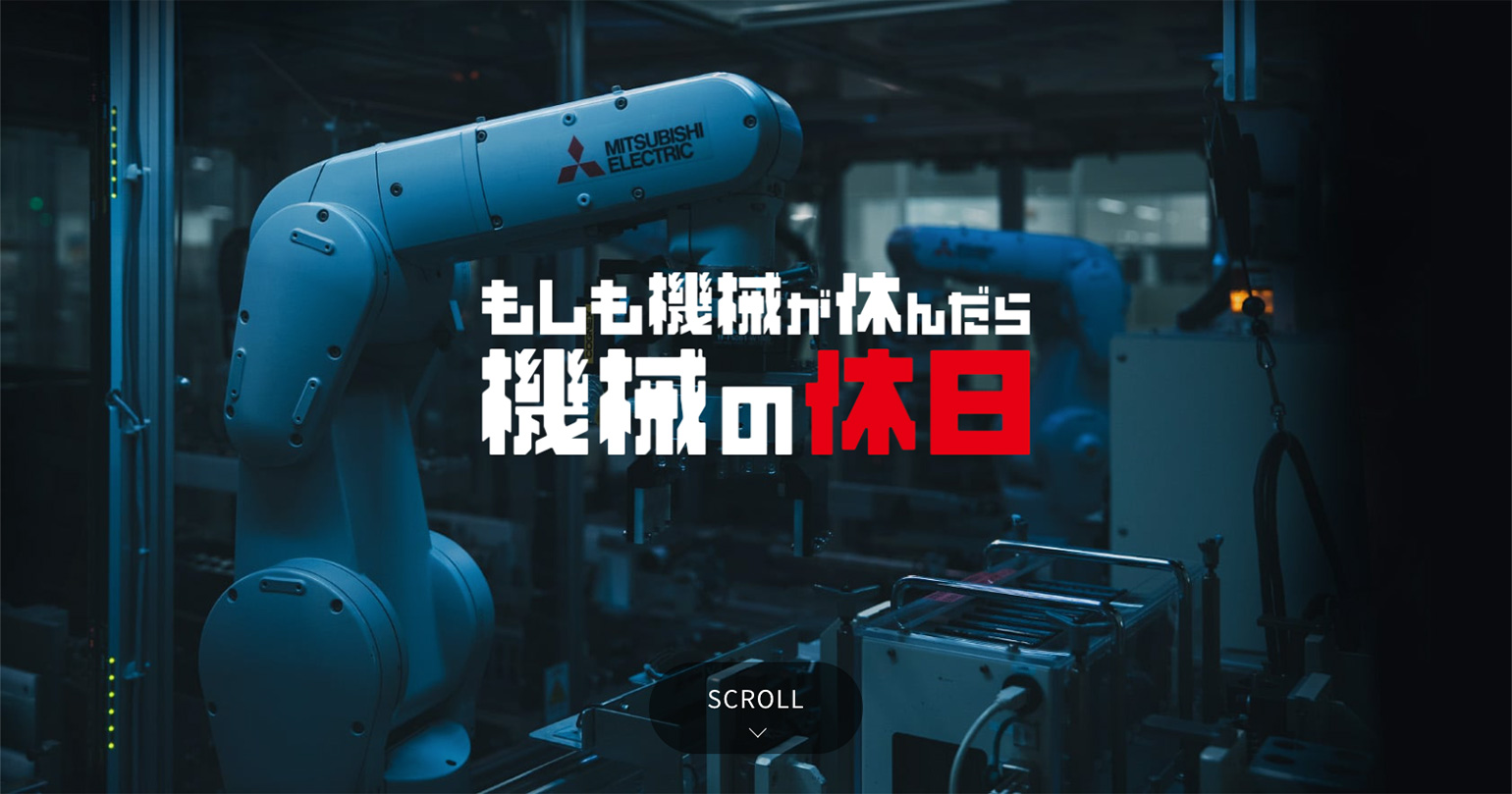
In this installment, we’ll introduce Mitsubishi Electric’s “What If Machines Took a Day Off?—Machines’ Day Off” project, which was launched in August 2025.
Created to coincide with “Machinery Day and Machinery Week,” established by the Japan Society of Mechanical Engineers, this project aimed to prompt consumers to reflect on the role and value of machines in their daily lives. What inspired its creation, and what vision lies behind it? Why did Mitsubishi Electric launch such a project? We spoke with Mr. Sada of Dentsu Inc., who was in charge of directing the planning strategy and copywriting.
[Profile of Mr. Sada] Dentsu Inc. Customer Experience & Creative Center Creative Director / Copywriter
The “What If Machines Took a Day Off?—Machines’ Day Off” Project: Fostering Understanding Through a Multi-Dimensional Design
Monthly CX: First, could you tell us exactly what kind of project “What If Machines Took a Day Off? ~Machines’ Day Off~” was?
Sada: Simply put, it’s an initiative designed to reexamine the relationship between people and machines. In recent years, due to advances in automation technology and labor shortages, machines are increasingly taking over tasks previously performed by humans. Against this backdrop, we created this project to communicate to a wider audience the importance of automation technology and the value of machines in today’s world.
The project consisted of three components: a web video, the “What If Machines Took a Day Off?” exhibition, and a dedicated website. It was a multi-faceted initiative designed to first create touchpoints with consumers through the web video and exhibition, promote the project via PR and social media, and then direct them to the dedicated website to deepen their awareness and understanding.
Monthly CX: We’d like to hear more about each of these in detail. Please start by telling us about the web video.
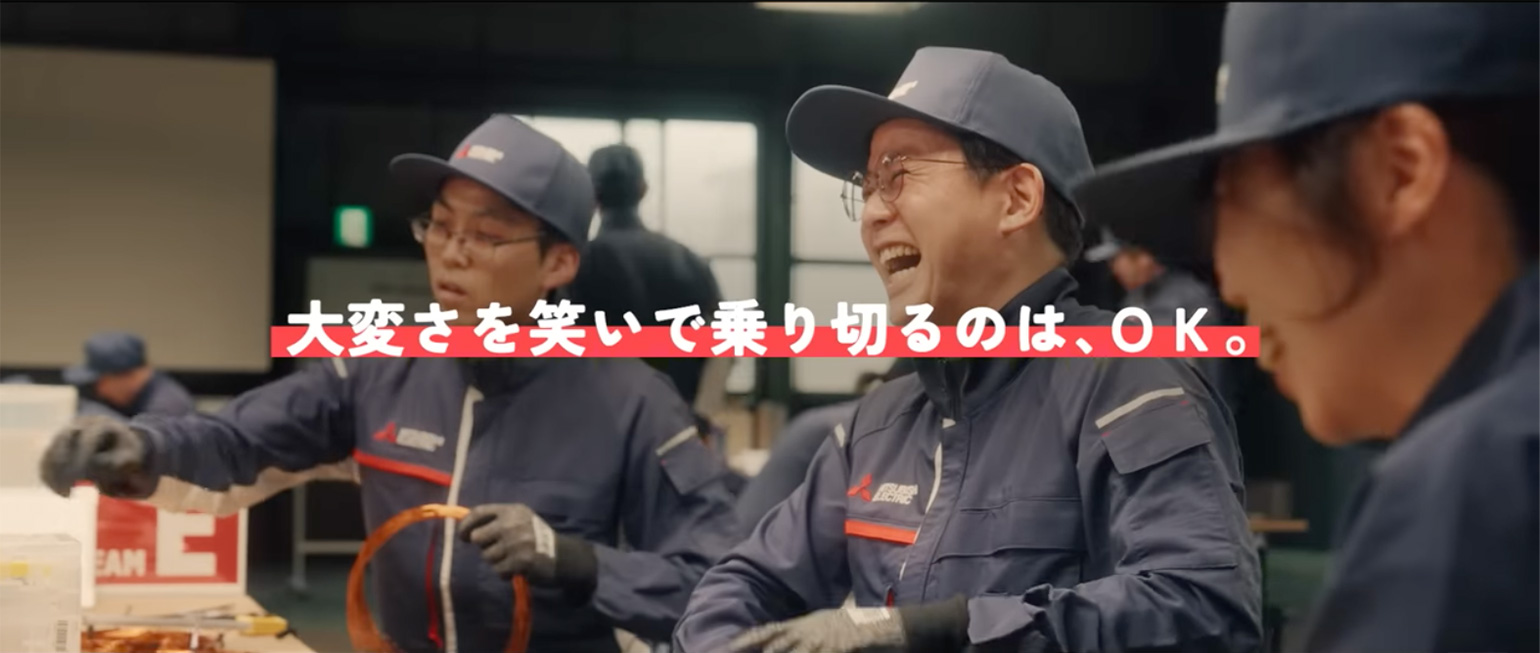
Sada: As the title suggests, this is a documentary-style video designed to convey “what would happen if machines stopped working.” We had Mitsubishi Electric employees experience tasks—such as coil winding and tightening screws—that are normally performed by machines in factories.
These were all tasks that humans simply couldn’t handle—such as “500 coil windings per minute” or “tightening a screw in 2 seconds per spot”—but we were careful not to portray it as a sci-fi disaster movie that stokes anxiety about a “world where machines have stopped.” Instead, we aimed for an entertaining presentation along the lines of, “Since the machines are taking a break, let’s have humans do it instead.”
Monthly CX: Just imagining the tasks makes it sound incredibly difficult…
Sada: The frontline employees who participated looked a bit grim at first, but they gradually rediscovered the importance of the machines they work alongside every day, saying things like, “We really can’t do without machines, can we?”
On social media, viewers who watched the video also shared touching comments, such as, “It brought a tear to my eye.”
Monthly CX: Next, please tell us about the exhibition initiative, “What If the Machines Took a Day Off?”
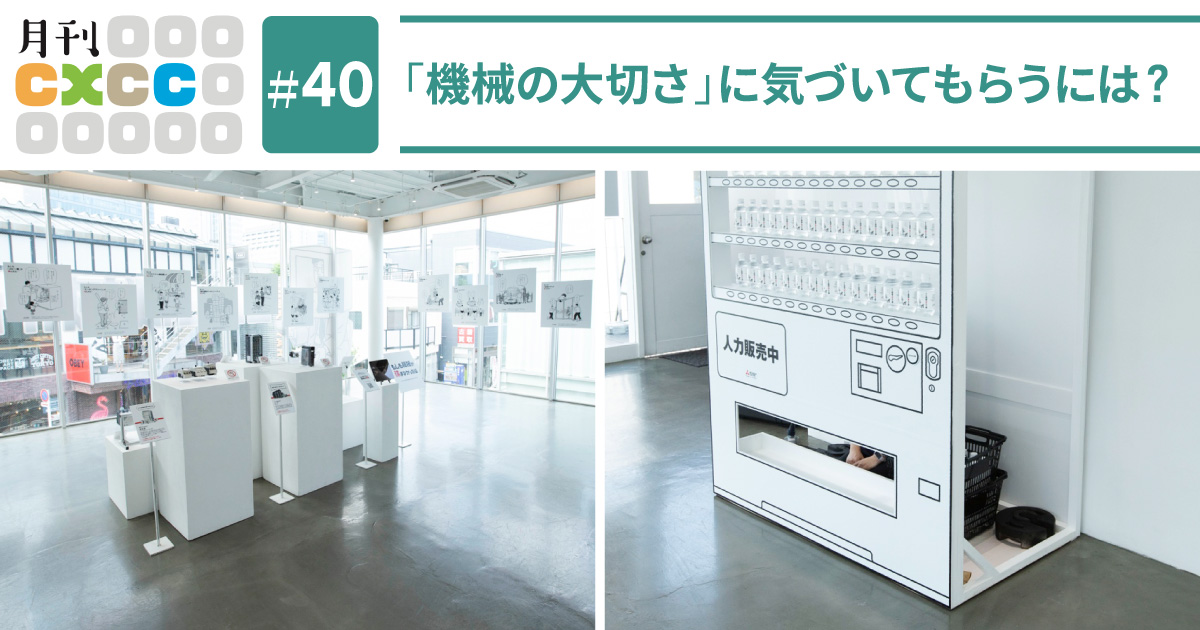
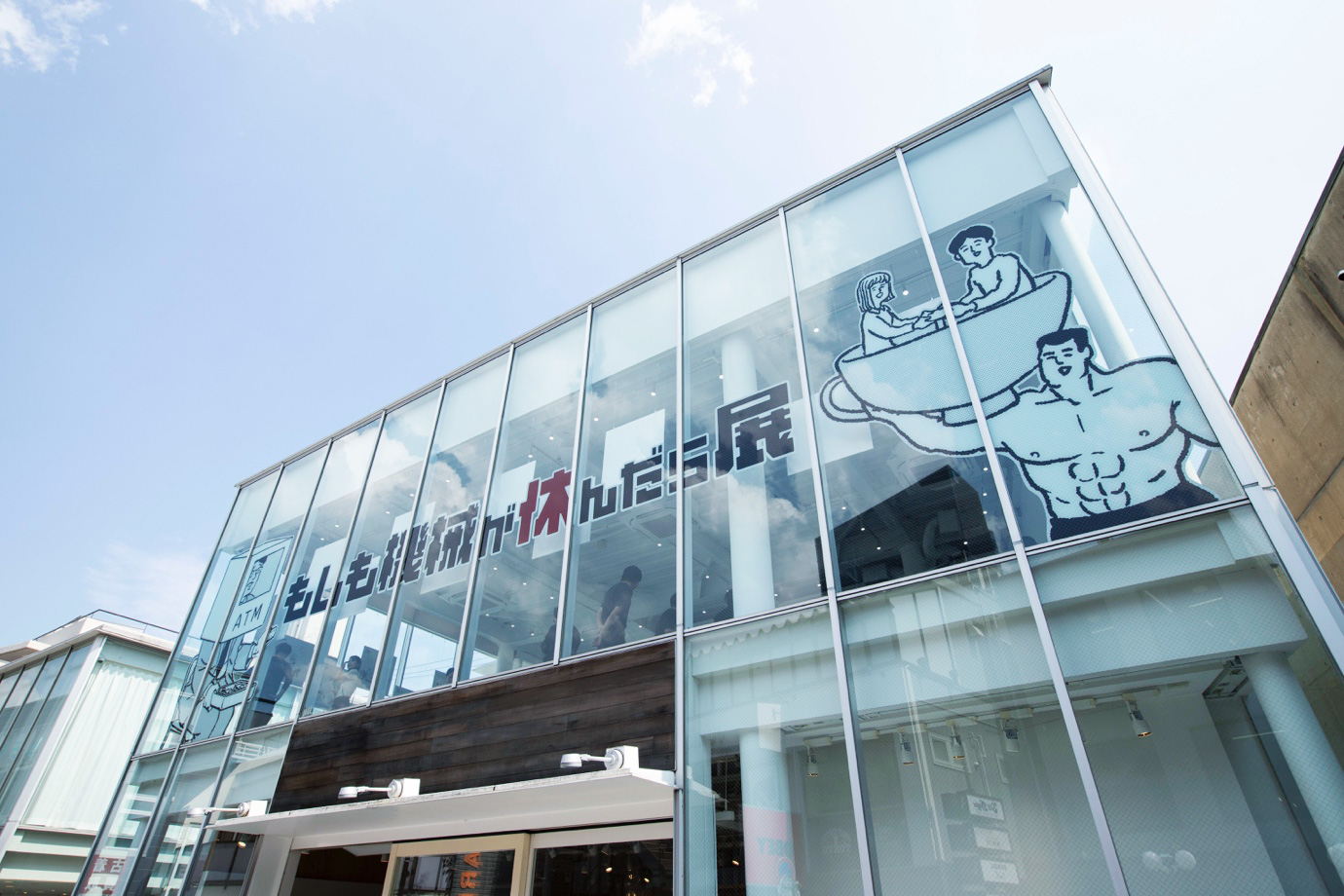
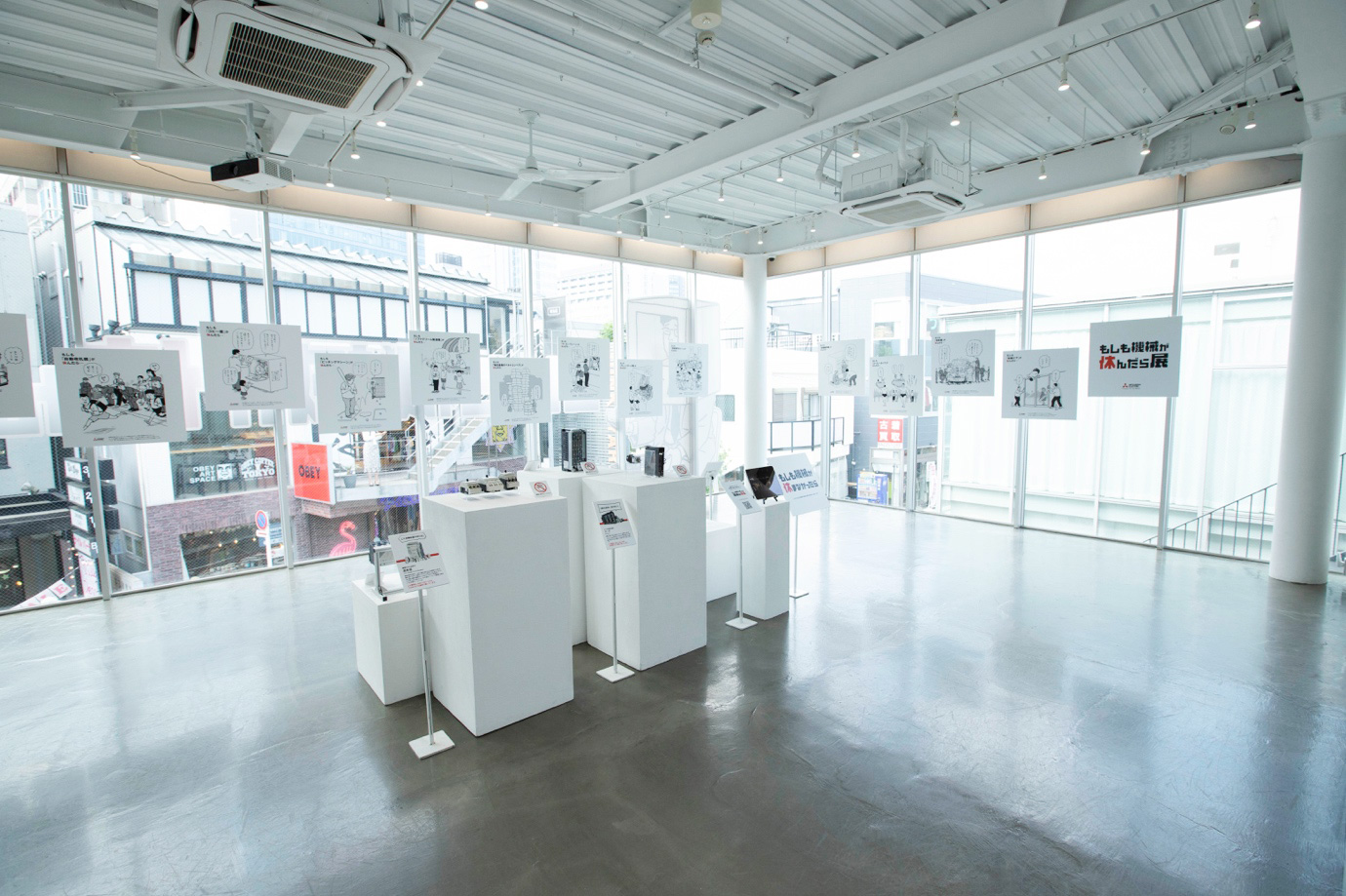
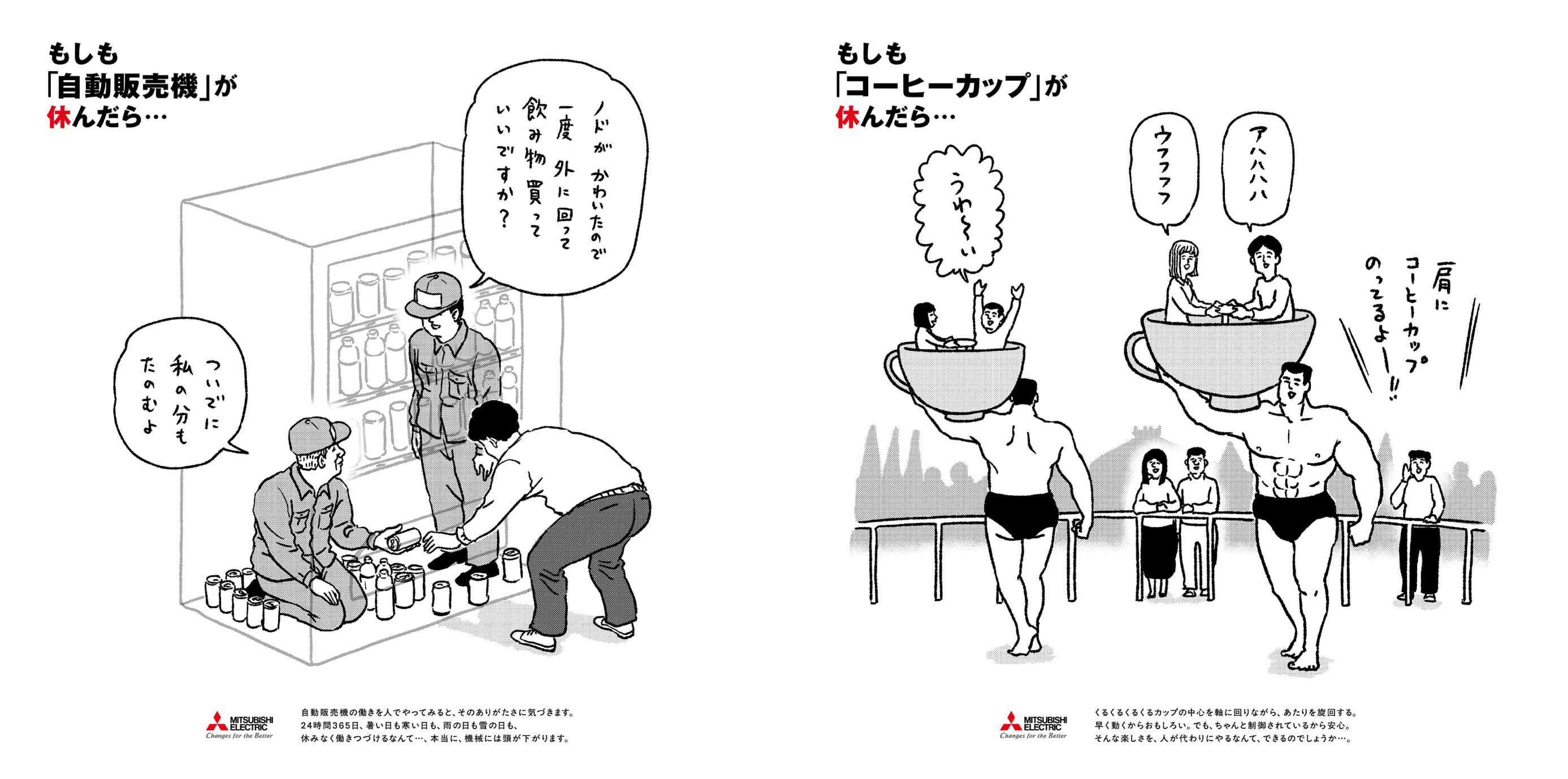
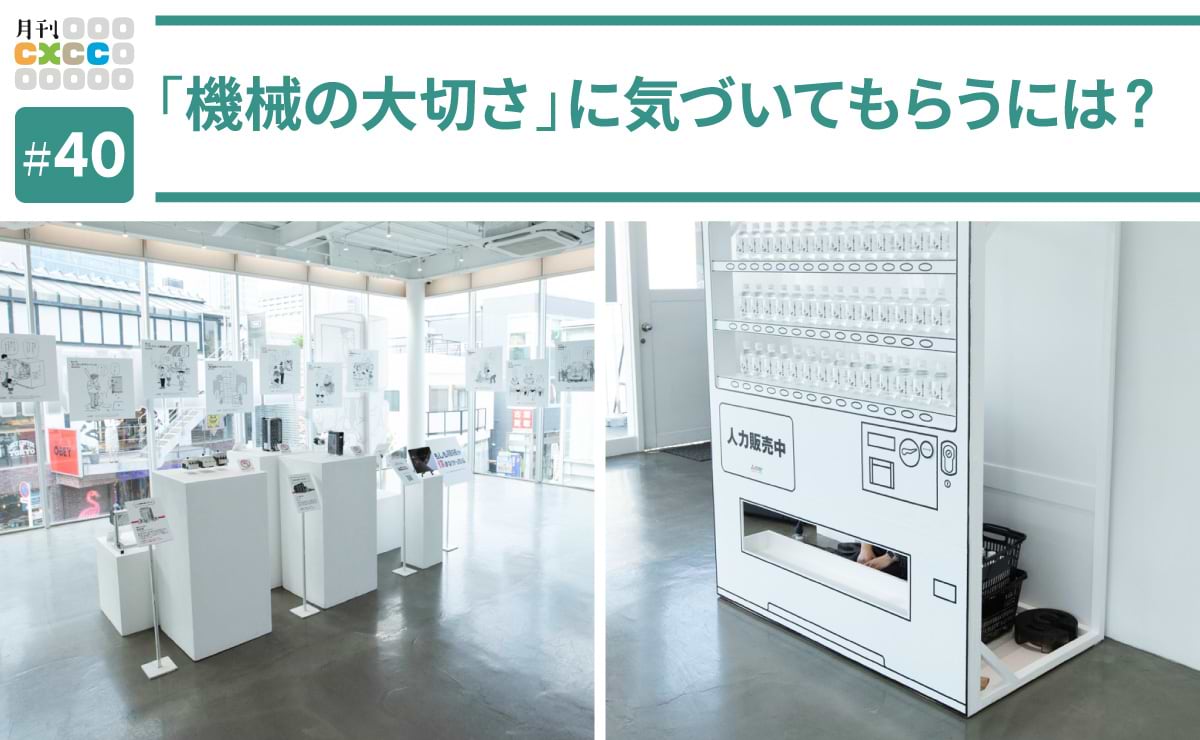
Sada: The “What If Machines Took a Day Off?” exhibition was a three-day event held in Harajuku from August 22 to 24, 2025. To showcase Mitsubishi Electric’s advanced automation technologies—such as automatic doors and vending machines—that support our daily lives, we presented illustrations depicting “what would happen if machines took a day off.”
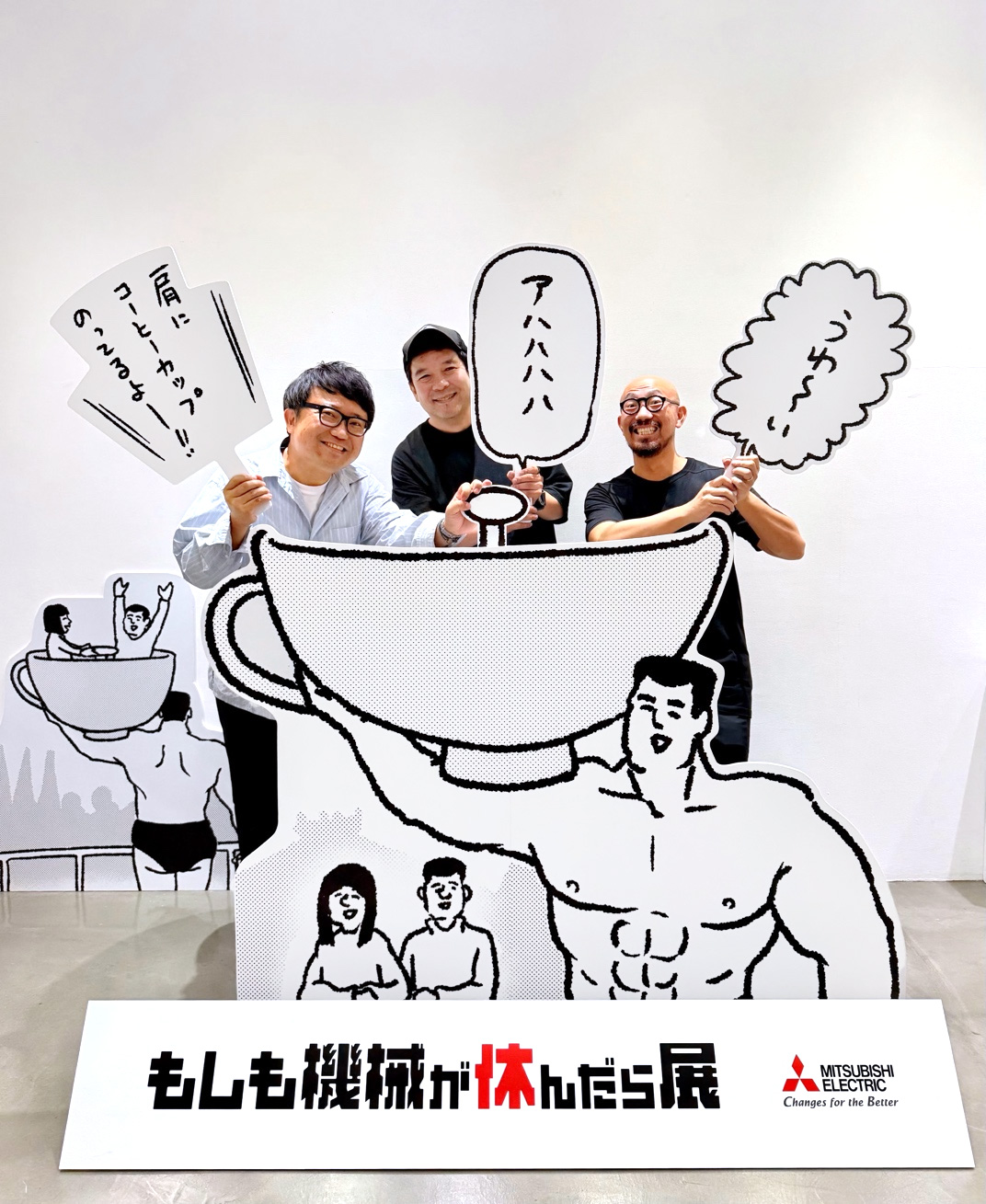
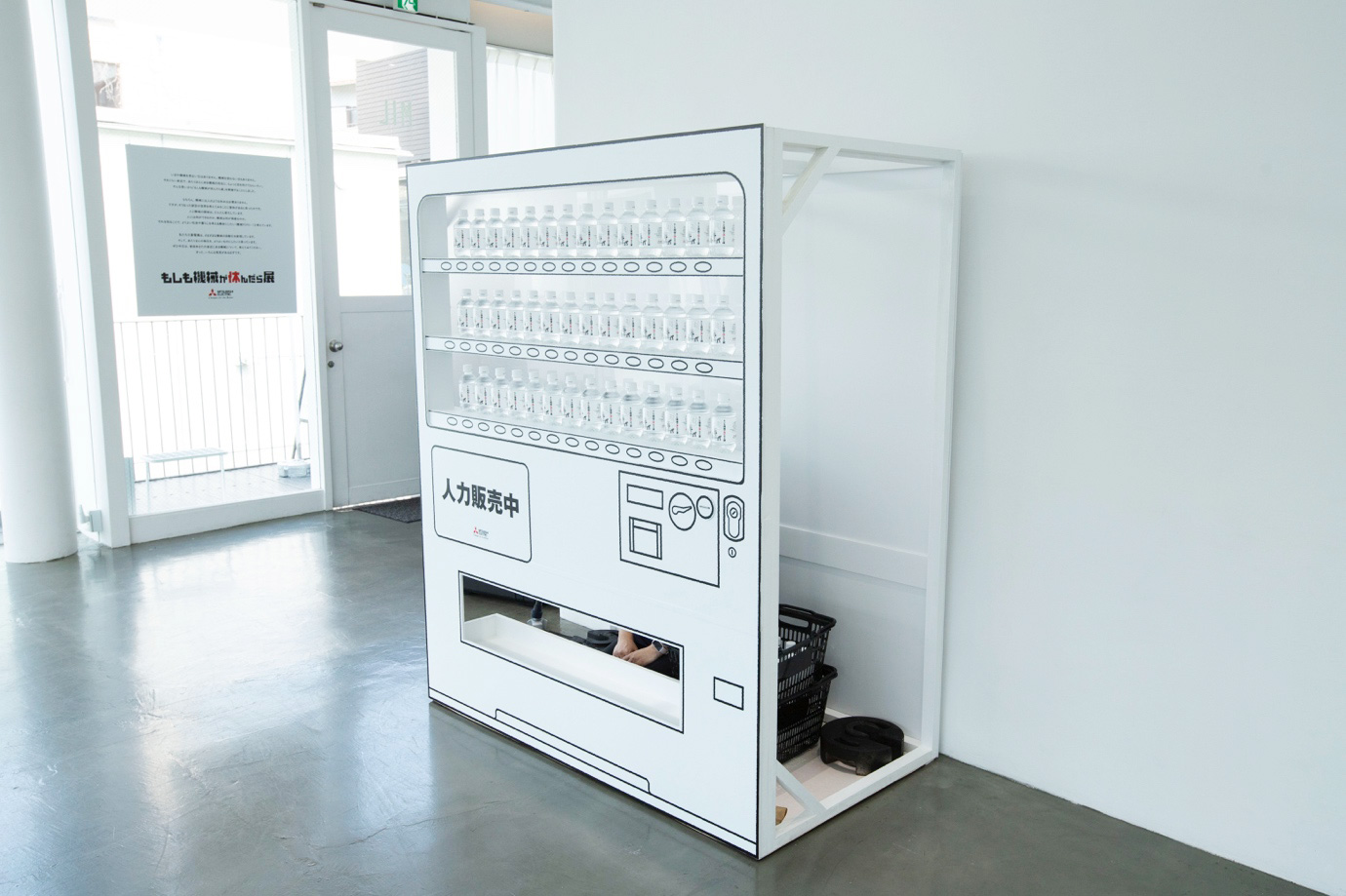
Scenes from the venueIllustrations actually displayed at the eventA photo booth was also set up inside the venue
The illustrations were created by Hikaru Tanaka, known for works such as “Salaryman Shigeru Yamazaki.” The “human-powered vending machine” was particularly well-received at the venue.
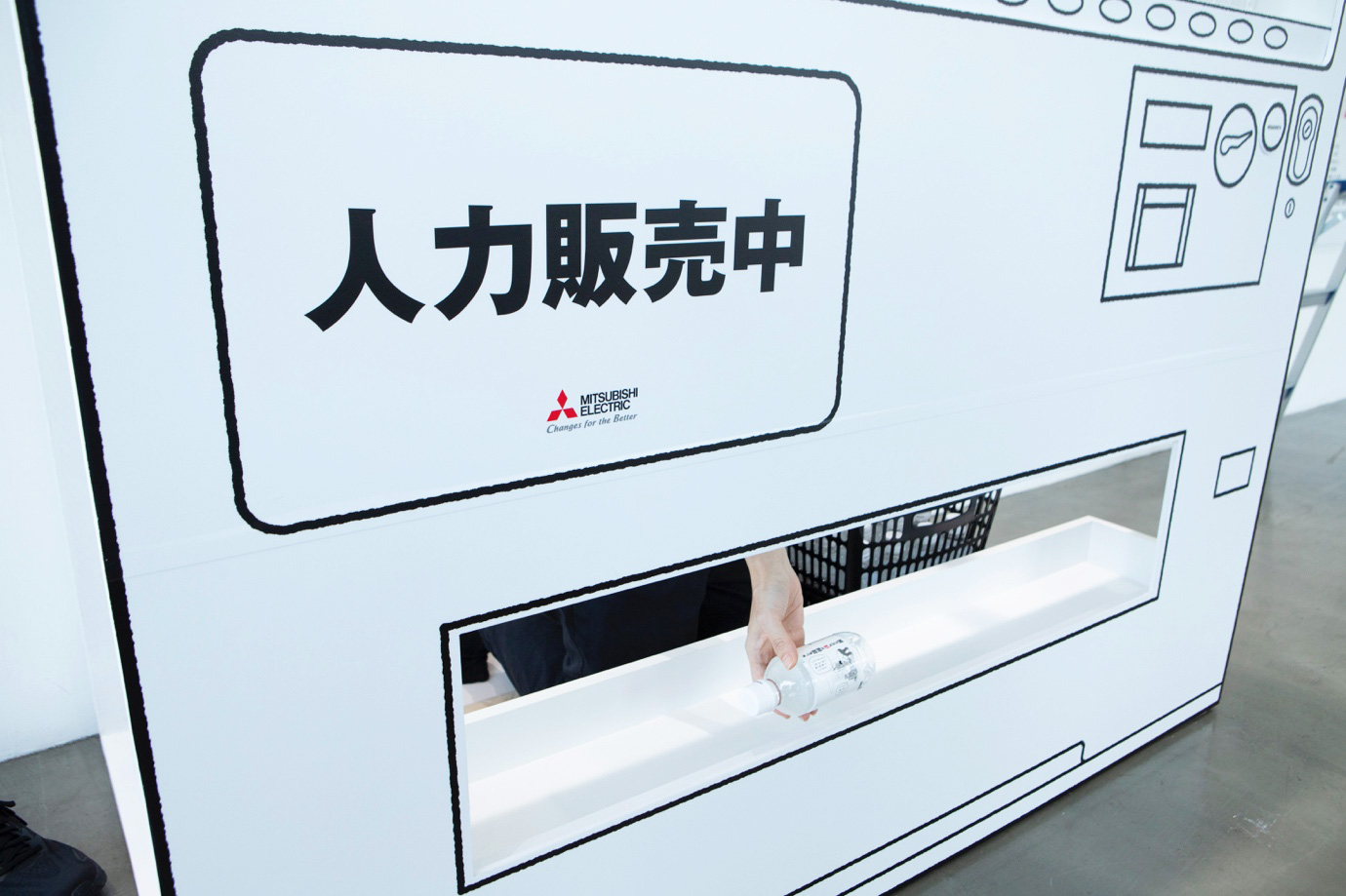
As a hands-on experience featuring some of the illustrations on display, we set up a “human-powered vending machine”—a box modeled after a vending machine that a person could step inside
Monthly CX: It really makes an impact, especially with a person’s hand reaching out from the dispensing slot.
Sada: It was an exhibit designed to show what would happen if a vending machine took a day off and a human took over instead. Through this human-powered vending machine, we were giving away original mineral water bottles illustrated exclusively by Hikaru Tanaka to visitors, but it seems the person operating it had a tough time. In the venue survey, we received comments like, “Please give the person operating the human-powered vending machine a break, too.”
Monthly CX: Please tell us about the special website as well.
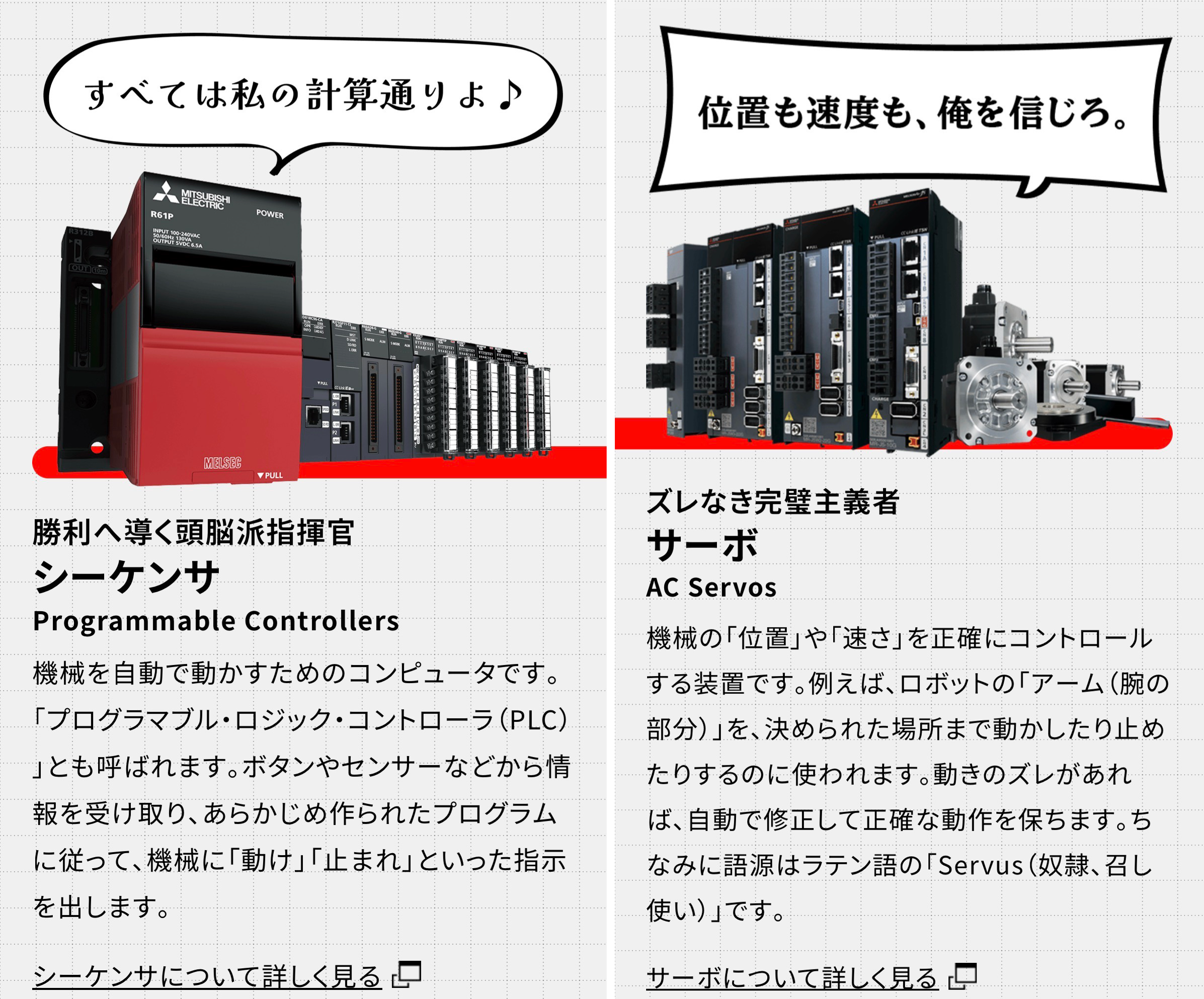
Personifying Machines to Introduce Their Functions
Sada: We created a special website to introduce the various machines that support automation in factory production processes. By personifying 11 machines and explaining their functions, I believe we were able to create an opportunity for visitors to deepen their understanding of automation technology.
Personifying the machines to introduce their respective functions
Monthly CX: What was the overall response like?
Sada: In the visitor survey conducted at the exhibition, approximately 95% of respondents answered that they were “extremely satisfied” or “satisfied,” and we received positive feedback such as “It gave me a chance to think about machinery” and “Machinery is necessary to realize a better society and way of life.”
Our client was also very pleased. The exhibition was featured in 75 media outlets, including TV programs, and I believe it contributed to Mitsubishi Electric’s branding as well.
The message won’t get through without each individual’s “realization”
Monthly CX: I thought this was a very meaningful project that reexamined the relationship between humans and machines. In that context, what was the significance for Mitsubishi Electric in carrying out this project?
Sada: For this project, we chose an approach where, by depicting the “absence of machines,” we aimed to make people aware of the “presence of machines” and their value. After all, machines are a given in our daily lives, and to be honest, even if someone says, “Machines are convenient, aren’t they? They’re amazing,” I think most people would think, “What’s the big deal?”
The automation initiatives undertaken by Mitsubishi Electric are exactly like that—while they’re familiar territory for B2B companies that work with machines, it’s difficult for B2C consumers like us to take a direct interest in them. This campaign was designed to address that gap and communicate the message to both B2B and B2C audiences.We hoped to convey Mitsubishi Electric’s vision regarding “how the company views collaboration between people and machines” and “what it can contribute to society and daily life in the future,” while also creating an opportunity for consumers to reflect on these topics themselves. Judging by the survey results, I believe we achieved our goal.
Monthly CX: What was the key point you focused on most, Mr. Sada, for the “What If Machines Took a Day Off?—Machines’ Day Off” project?
Sada: Ultimately, it was about letting people simulate the experience of a world where machines take a day off. By simulating this experience, they realize, “It would be really tough without machines.” That “realization” was the key point of this initiative.
As I mentioned earlier, no matter how much we tout how amazing machines are, it no longer resonates because they’ve become so commonplace. However, when people simulate a scenario without machines, they start to think, “How would my life change?” or “What would I have to do instead?”—they internalize it as something that affects them personally, leading to a deeper realization. I was extremely particular about designing that “after-reading impression.”
Monthly CX: That’s exactly what “CX Creative” is all about.
Sada: The ultimate message we wanted to convey—the “importance of machines in modern society”—cannot be truly understood unless people arrive at it through their own experience, rather than through words alone. Copy can provide the trigger for reflection, but the outcome is something each individual must arrive at on their own; it cannot be forced upon them. In particular, it’s difficult to get people to understand a message like “our lives are enriched and supported by machines” through words alone; it won’t truly resonate unless they experience and understand it for themselves.
During the review of this campaign, the client mentioned, ‘There’s likely a difference in the depth of awareness between people who simply knew about Mitsubishi Electric and those who learned about it through this project,’ and I think that’s exactly right. I’d be happy if those who engaged with the content were to suddenly recall this campaign when they see the Mitsubishi Electric logo in their daily lives.
Monthly CX: Could you tell us what was the most challenging part of this campaign?
Sada: I wouldn’t exactly call it a struggle, but we did take great care to coordinate closely with the client. While Mitsubishi Electric has run various mass advertising campaigns in the past, there were few precedents for initiatives like this one.
Therefore, we had extensive discussions—not just on how to convey the message that “machinery is important” through mass advertising, but specifically on how to foster a deeper “realization” from the audience’s perspective. While each initiative is different, the goal was to use common copy to create the same aftertaste—that is, to spark an awareness of machinery. I feel that successfully aligning our perspectives on this point was key to making this a successful campaign.
We hope to continue expanding the ways we approach these challenges.
Monthly CX: Looking back on this campaign, what are your thoughts?
Sada: This campaign was launched at a time when technologies like AI, as well as serving robots and touchscreen ordering systems at family restaurants, were beginning to take root. It was a moment when labor-saving measures were gaining full momentum alongside energy and resource conservation, and I felt a strong sense of purpose in being involved in this campaign.
I feel that for Japan to compete on the global stage in the future, collaboration with machines must become much more commonplace. I think this applies, for example, to self-checkout lanes at convenience stores and supermarkets as well.
I find it truly regrettable when people feel uncomfortable with such machines, let alone actively dislike them. That’s precisely why I hope initiatives like this one can help improve Japanese society and contribute, even in a small way, to changing public perceptions. I would be very happy if this content had even a slight positive impact on those who engage with it.
Monthly CX: Finally, Mr. Sada, could you tell us what challenges you’d like to take on in the future?
Sada: Even with the same experience, whether it leaves a lasting impression on a person depends on the depth of their insight. The approach I take varies depending on the client’s challenges, so I want to keep expanding my repertoire of solutions. I aim to identify the essence of each challenge and implement the optimal strategy to address it—and to do that, I plan to continue learning and putting what I learn into practice.
(Editor’s Note) In this issue, we spoke with Ms. Sada about Mitsubishi Electric’s “What If Machines Took a Break?—A Day Off for Machines” project, which was launched in August 2025.
This initiative reexamines the relationship between humans and machines. By virtually experiencing a world where machines take a break, those who engaged with the content likely gained deep insights and were able to reframe the concept as something personally relevant, asking themselves, “How would my own life change?”
Mr. Sada’s remark—that “while copy can spark thought, the outcome differs for each individual, so we cannot impose it through copy alone”—struck me as a golden rule for all creators.
If you have any requests regarding topics or themes you’d like us to cover in the future, please send a message to the Monthly CX editorial department via the contact page below. Thank you as always for your continued readership.
Monthly CX Editorial Department Dentsu Inc. CXCC: Kihata, Koike, Otani, Okumura, Kosugi, Yi, Saito, Oda, Takakusaki, Kanasaka
The information published at this time is as follows.
We plan and execute a wide range of initiatives, from mass media advertising to coordinated middle- and bottom-funnel strategies, as well as experiential events. We strive to identify the root causes of challenges and develop plans to resolve them. We have particularly extensive experience in branding centered around digital video.
Monthly CX Editorial Department
Dentsu Inc.
CXCC (CX Creative Center)
The editorial team for "Monthly CX," a series where members of Dentsu Inc.'s CX-specialized division "CXCC" share insights on CX and creativity. By covering outstanding CX creative success stories within the agency or company, we unravel the essence and potential of CX creativity. Core members are Yoko Kibata, Hiroshi Koike, Nao Otani, Hirono Okumura, Yutaro Kosugi, Espin, Keisuke Saito, Kenji Oda, Hirozumi Takakusagi, and Motofumi Kanasaka, all belonging to CXCC.

 Monthly CX [40/40]