
Note: This website was automatically translated, so some terms or nuances may not be completely accurate.
The Japanese Luxury Market: An Era of “Readjustment.” “The frenzy is over. But the market is not.”
Post-pandemic “revenge spending,” a rapid recovery in inbound tourism, and a historically weak yen. Japan’s luxury market has expanded on the back of these multiple tailwinds, but according to Statista’s market insights, this growth has entered a correction phase, with a projected -2.5% growth rate in 2025.
However, this is not simply a market contraction. It is a phase of “realignment” in which customers are reevaluating whether products offer “value for money,” bringing the differences between brands into sharp relief. Based on the “Japan Luxury Landscape Report 2026” compiled by the strategy team at Dentsu Japan International Brands Inc., we will examine the four conditions brands must meet to be chosen again in a mature market.
<Table of Contents>
▼It’s Not That the Market Has Shrunk—The Criteria for Being Chosen Have Become More Stringent
▼Purchasing Isn’t Everything—Brands Are Now Judged on How They Remain Relevant in Customers’ Lives
▼Simply Localizing for the Japanese Market Is No Longer Enough to Differentiate Yourself
▼A Media Outlet’s Competitiveness Is Determined by Its Role and Sequence, Not the Volume of Ads Placed
The market hasn’t shrunk. The criteria for being chosen have become more stringent
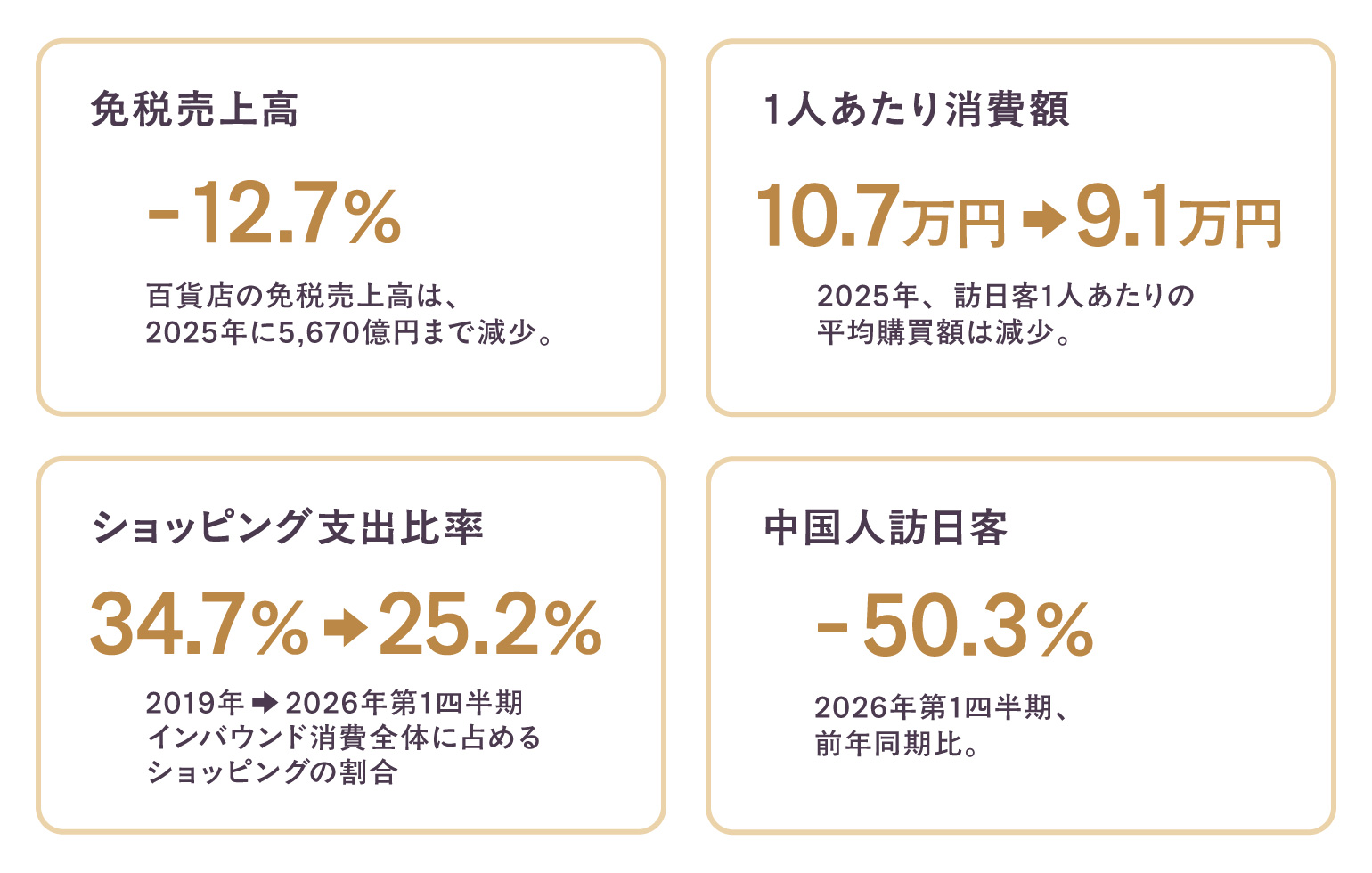
Rather than the overall size of the market, we should first look at its composition. In 2025, the number of international visitors to Japan reached a record high of 42.68 million, and consumer spending by foreign tourists in Japan totaled 9.4559 trillion yen (*). However, looking at the breakdown of spending, accommodation costs accounted for the largest share at 36.6%, while shopping expenses remained at just 27.0%.Even though the number of visitors to Japan and total travel spending have increased, this does not necessarily translate directly into growth in luxury spending.
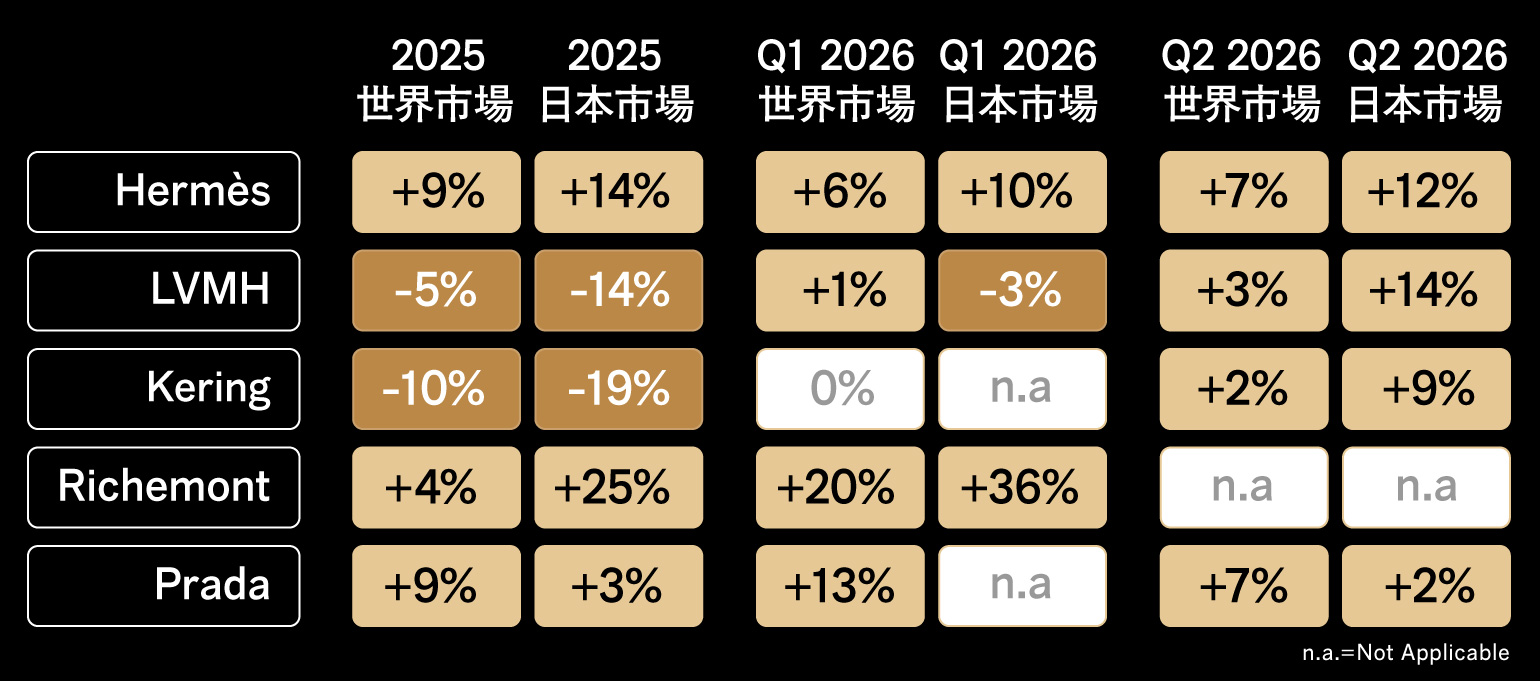
*n.a. = Not Applicable
Looking solely at overall market figures, it appears that the slowdown is affecting all brands uniformly. In reality, however, the disparities between brands are actually widening. For example, Hermès’ 2025 sales in Japan increased by 14% year-over-year on a constant-currency basis. The company attributes this growth to the loyalty of its Japanese customers and its rigorous distribution network.As tailwinds weaken, relationships with existing customers, price acceptance, and brand-specific value will increasingly determine the difference between success and failure.
In other words, what is happening now is not a disappearance of demand, but a shift in the competitive landscape. If we view post-pandemic rebound demand and the weak yen as the very drivers of growth, the slowdown in 2025 may appear to be a “market contraction.” However, when these external factors are removed, what becomes apparent is a brand’s true underlying strength.
We view this shift as a transition from the “Era of Enthusiasm” to the “Era of Fundamentals.”
The same pattern holds true for other mature categories, such as automobiles, cosmetics, finance, and durable goods. Marketers must look beyond mere fluctuations in market size to identify who continues to support the brand, why they choose it, and where their spending is shifting. Strategy in mature markets begins not with predicting growth rates, but with identifying how the criteria for being chosen have changed.
*Source: Japan National Tourism Organization, “Number of Inbound Visitors (December 2025 and Annual Estimates)”; Japan Tourism Agency, “Consumption Trends of Inbound Visitors: Survey Results and Analysis of Inbound Consumption Trends”
Purchases aren’t everything. Brands are challenged to maintain a presence in customers’ lives
Rising prices have not caused consumers who can no longer purchase as frequently as before to lose interest in the brand altogether. They continue to maintain a connection with the brand’s worldview through exhibitions, cafés, cosmetics, fragrances, and accessories. The more affluent the customer, the less satisfied they are with generic perks; instead, they increasingly seek special treatment tailored to their preferences and purchase history.
For the affluent in particular, the very fact that a brand maintains a continuous presence in their lives—encompassing culture, travel, dining, and even living spaces—is what creates value. A common pitfall here is categorizing customers into just two groups: “buyers” and “non-buyers.”By designing multiple layers of engagement—including awareness, empathy, participation, ownership, continued use, and recommendation—the relationship remains intact even if purchase frequency declines. One-time VIP events or follow-ups immediately after a purchase are no longer sufficient. It is essential to continuously provide touchpoints where customers can engage with the brand’s worldview on a daily basis.
The same shift is evident in product selection. According to the 2026 edition of the “BLUX Brand Survey”—a luxury consumer survey conducted by the Dentsu Group—“durability” accounted for 31.8% of the values sought in luxury products, “timelessness” for 28.9%, and “the ability to be oneself” for 22.4%.
Items featuring prominent logos are being replaced by soft bags, charms, clothing that’s easy to layer, eyewear, and the habit of switching between multiple fragrances—all of which are gaining popularity—because consumers are beginning to prioritize their own personal combinations over the “correct” choices dictated by brands.
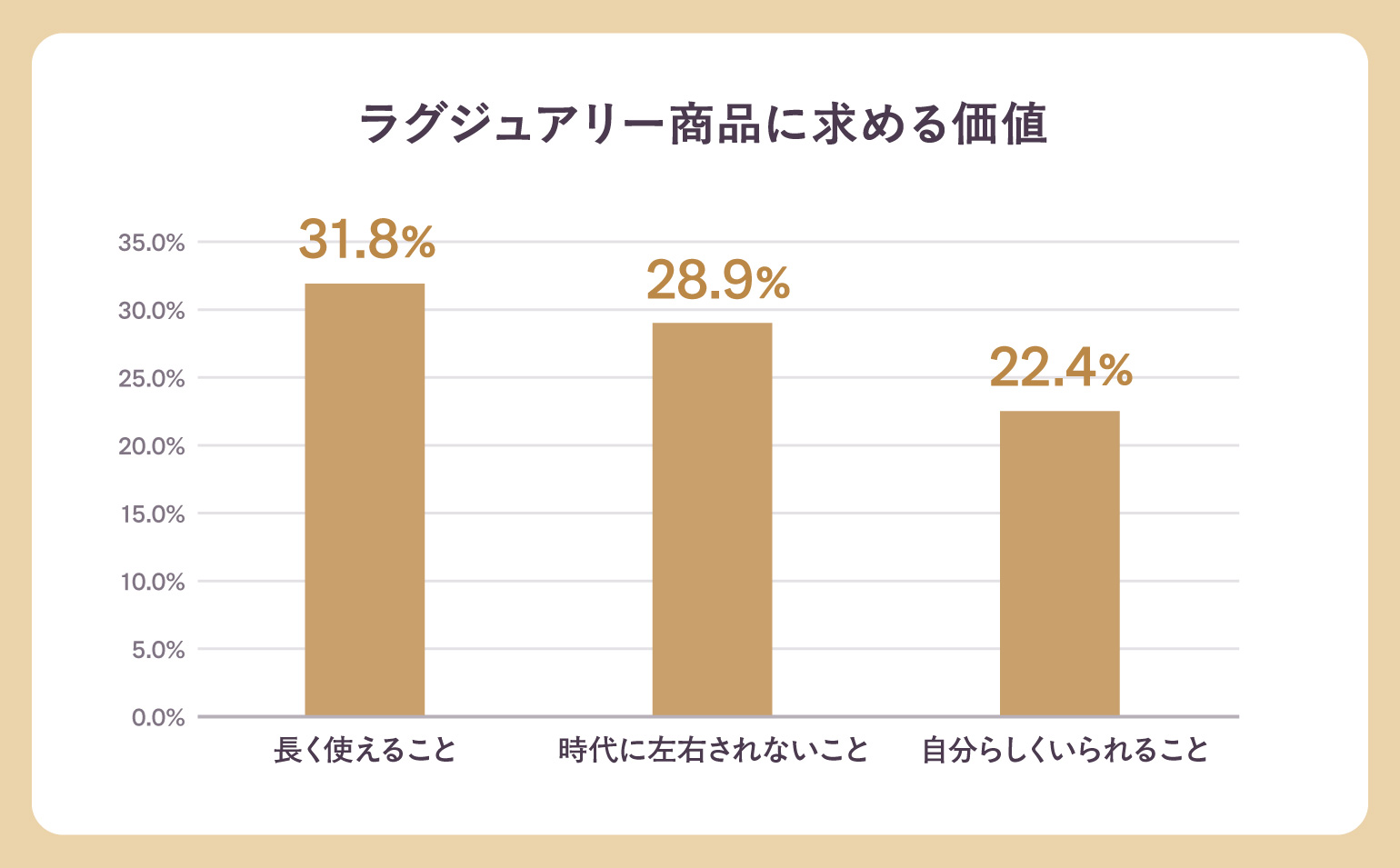
Consequently, the role of brands is shifting from unilaterally imparting a predefined meaning to providing the space for customers to create their own meanings. In mature markets, CRM must be transformed from a mere mechanism for promoting repeat purchases into a foundation for recording and nurturing customers’ interests and engagement history. The same applies to product strategy.
Rather than items designed to capitalize on fleeting trends, a product lineup that can be used for a long time, easily combined with other items, and gradually expanded over time is what builds long-term relationships with customers.
Simply translating for the Japanese market is no longer enough to differentiate yourself
Appointing Japanese brand ambassadors, using Japanese copy, releasing limited-edition products featuring cherry blossoms, and opening flagship stores in Ginza and Omotesando—these localization efforts have now become the bare minimum for entering the market. While it’s important to execute them carefully, doing so alone has made it increasingly difficult to create “meaning unique to the brand.” Simply borrowing Japanese culture as superficial symbols may foster a sense of familiarity, but it does not lead to uniqueness; rather, it risks reinforcing a sense of déjà vu.
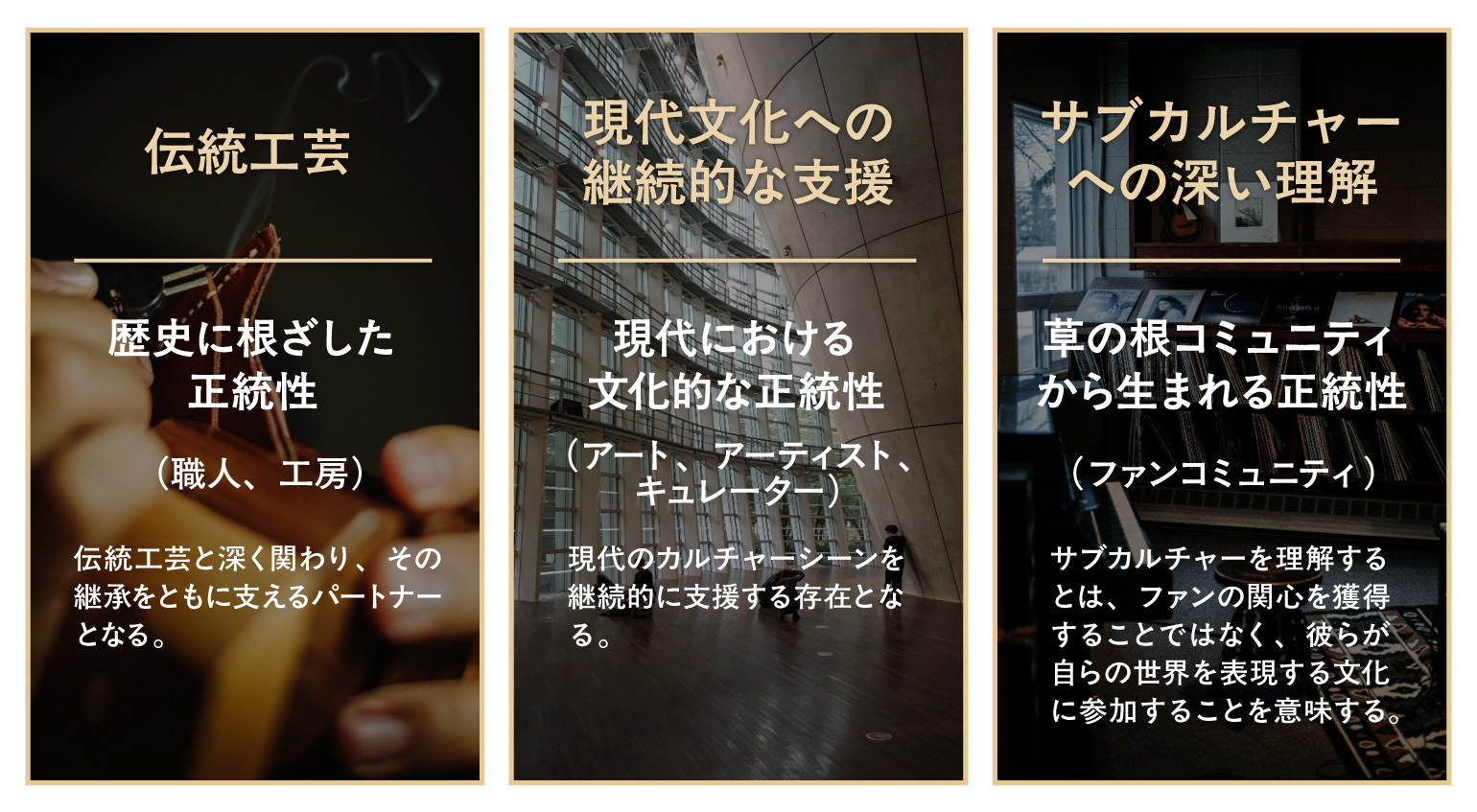
The next necessary step is an approach we call “culturalization.” This refers not only to translating global brand assets for the Japanese market but also to building relationships with the people who actually create and sustain Japanese culture, and jointly generating new value from those connections. The scope is not limited to traditional crafts. From contemporary art, music, film, food, and architecture to youth subcultures—any place where culture is being created can be a potential focus.
The “Miu Miu Jazz Club Tokyo 2026,” held in May 2026, is a prime example of this.The event marked the reopening of the Ginza flagship store by transforming it into a space inspired by Japanese jazz and café culture, and was held in a venue that retained the atmosphere of the Showa era. At the heart of the program was the lineage of female musicians who have shaped Japanese jazz, alongside the current generation of active artists. Crucially, the music was not treated merely as decoration; instead, its history, the venue itself, and the artists were placed at the core of the project.
When engaging with culture in a mature market, the question is not “What can we borrow?” but “How can we contribute to its development?” It is essential to design initiatives in advance to ensure continuity, give back to cultural practitioners, and clearly articulate the project’s roots—rather than letting the effort end with a one-off collaboration. This does not mean weakening the brand’s message. On the contrary, identifying precisely where the company’s values intersect with local culture is what builds trust that competitors cannot easily replicate.
A media outlet’s competitiveness is determined by its role and sequence, not by the volume of ad placements
In 2025, Japan’s total advertising expenditure reached a record high of 8.0623 trillion yen, with internet advertising spending totaling 4.0459 trillion yen—accounting for 50.2% of the total and surpassing the 50% mark for the first time. While advertising spending is concentrated in digital channels, there is concern that many brands are competing on the same screens, in the same formats, and using the same optimization metrics. We believe that simply increasing the volume of impressions is no longer sufficient to enhance a brand’s cultural presence or build consumer trust in pricing.
This is precisely why “media orchestration” is so important. It is not a difficult concept. It involves assigning different roles to each medium and connecting them in the order that customers actually experience them. Social media fosters aspiration and everyday conversation, while video and connected TV deepen the narrative.Magazines, newspapers, outdoor advertising, and audio media provide cultural authority and a unique, on-the-ground atmosphere, while search, retargeting, and AI-powered search capture intent that has already begun to take root.
This does not mean we should stop pursuing scale in reach. It means distinguishing between “touchpoints that build broad awareness,” “touchpoints that foster deep understanding,” and “touchpoints that capture customer action,” and designing the campaign so that the impact of each is effectively passed on to the next touchpoint. Regarding performance metrics, rather than measuring everything solely by short-term sales, they should be set according to the specific role each medium plays—such as brand recall, branded searches, store visits, membership sign-ups, and repeat purchases.In mature markets, the difference in competitiveness lies not so much in which channels you choose, but in how you design their roles and sequence.
What these changes have in common is that the depth of the relationship is more important than volume. Now that external tailwinds have weakened, the question is no longer just “How can we sell more?” It is “What is the reason this brand should continue to be a part of the lives of the customers we truly want to connect with?”In the luxury market, where prices are high and purchases are closely tied to identity, this question arises more quickly and acutely than in any other market. That is precisely why the luxury sector serves as a leading indicator.
Dentsu Japan International Brands Inc. bridges the core values that global brands must uphold with the new meaning they must create in the Japanese market.Our value lies in integrating market analysis, customer insight, product and communication design, and media orchestration into a single, cohesive growth strategy—rather than treating them as separate disciplines. Is your market truly shrinking, or have the “criteria for selection” themselves changed? If you’d like to begin by assessing this, please feel free to contact Dentsu Japan International Brands Inc.
Clickherefor a summary of the report.
Was this article helpful?
Share this article


Newsletter registration is here
We select and publish important news every day
For inquiries about this article
Author
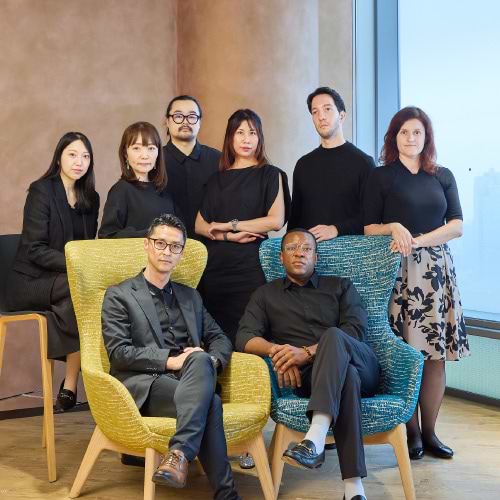
DJIB Strategy Team
Dentsu Japan International Brands Inc.
Strategic Planning Department