Note: This website was automatically translated, so some terms or nuances may not be completely accurate.
 Exploring Japan's Potential Through Dentsu Inc. Japan Brand Research [3/3]
Planners Analyze the Appeal and Challenges of Japanese Brands: “Japanese Products” Edition
The “Japan Brand Survey,” Dentsu Inc.’s proprietary survey targeting middle- and high-income consumers overseas, underwent a major overhaul in 2022 (for an overview, see here ), this series explores the current state of the Japan brand and Japan’s future potential.
The theme of this installment is “Japanese Products.”
<Table of Contents>
▼ The Power of Free Thinking and Collective Intelligence
▼ Logos, Ethos, and Pathos
▼ The Bird’s-Eye View and the Insect’s-Eye View
▼ Striving for the Ideal, Yet Never Underestimating Reality
▼If You Know Your Enemy and Yourself, You Will Never Be Defeated in a Hundred Battles
▼The Wisdom of Not Knowing
Free Thinking and the Power of Collective Intelligence
Before getting into the main topic, I’d like to touch on the social context.
Since the latter half of the 2010s, we’ve frequently heard the argument that Japan is lagging behind in digital transformation. Furthermore, regarding the social environment, there are scattered opinions suggesting that, compared to the golden age of the Japanese economy, a sense of stagnation and stagnation has taken hold, and both individuals and organizations no longer have the leeway to enjoy a sense of breathing room.
That said, each of us living in this environment cannot simply remain bystanders. Many people are likely struggling in their respective roles while desperately searching for a way forward.
Strangely enough, despite the uncertainty, complexity, and lack of precedents or definitive answers, we tend—for better or worse—to rush headlong in pursuit of “clarity that we can understand.”There is a growing trend toward valuing approaches that frame issues in binary oppositions—such as left brain versus right brain, digital versus analog, global versus domestic, traditional large corporations versus startups, market-in versus product-out, lifetime employment versus performance-based pay, and top-down versus bottom-up—and attempt to persuade through seemingly plausible logical analysis.
However, amid the irreversible social shifts brought about by the VUCA era and the COVID-19 pandemic, I believe that when confronting the grand theme of the current state and potential of the “Japan Brand,” the wisdom of a single individual, a single winning formula, or a single approach is no longer sufficient to break through the barriers facing Japanese products—and creating new appeal would be harder than reaching the sky.
A single piece of data can be interpreted in many ways. This series may be far from presenting answers that everyone can instantly relate to, but I hope it will serve as a catalyst to draw out a variety of insightful perspectives. With respect for free thinking and the power of collective wisdom.
Logos, Ethos, Pathos
In his “Rhetoric,” Aristotle argues that three elements—Logos (logic), Ethos (character/trust), and Pathos (emotion/empathy)—are indispensable for persuading others. The essence of purchasing a product is the very product of Logos, Ethos, and Pathos.
In this installment, we’ll explore product image through:
① Functionality
② Price
③ Service
④ Usability
⑤ Safety
⑥ Brand Image
⑦ Design
We classified these into seven categories and further broke them down into 33 subcategories to conduct a highly detailed survey.
Here, I will offer some insights based on the three essential elements required for Japanese products—Logos, Ethos, and Pathos.
A. Logos: “Functionality, Price, Service, and User Experience” (i.e., logic), where reason and comparative analysis play a strong role
B. Ethos: “Safety” (i.e., character/trust), which represents the character and trustworthiness of the product or company
C. Pathos: “Brand Image and Design” (i.e., emotion/empathy), which reflects the brand’s narrative and aesthetics
A. Logos: “Functionality, price, service, and user experience”—where reason and comparative analysis play a strong role (i.e., logic)
First, over 70% of respondents hold the perception that Japanese products are “superior in functionality.” In other words, it can be said that Japanese products demonstrate a significant advantage in the “Logos” category compared to products from other countries.
Furthermore, within the category of functionality, “high performance” and “high-tech” received the highest ratings, far surpassing other items.
In addition, it was found that characteristics common to many Japanese products—such as “meticulous craftsmanship,” “practicality,” “attention to detail,” and “durability”—are also highly valued.
B. Ethos: “Safety” (= Character/Trust), which represents the character and reliability of a product or company
Next, regarding “Safety”—which falls under “Ethos”—there is a strong perception that products “seem safe to use,” and the sense of reassurance associated with “Made in Japan” has firmly taken root.
C. Pathos: “Brand Image and Design” (equivalent to “Emotion/Empathy”), which reflects the brand’s story and aesthetics
Furthermore, regarding “Pathos”—defined as brand image and design—attributes such as “high quality” and “reliable” are rated most highly, which can be seen as reinforcing the elements of “Logos” (high performance, high-tech) and “Ethos” (sense of security).
On the other hand, items such as historical and cultural heritage, good taste, and beauty received relatively low scores, leaving a slight sense of dissatisfaction when viewed through the lens of the brand’s story and aesthetics.
A Bird’s-Eye View and a Bug’s-Eye View
We often casually use geographical categorizations such as “the West,” “ASEAN,” or “Asia” in our daily lives. In certain situations, such categorizations are indeed very convenient.
However, from the perspectives of marketing and cognitive psychology, such classifications often lead to errors and misconceptions. There is a risk that they will oversimplify the thinking and initiatives that should, in fact, address complexity and diversity.
In this survey, even among Western European countries, significant differences were observed in perceptions of Japanese products across many categories.
For example, regarding “high-tech,” perceptions in the United Kingdom were roughly on par with the overall average and significantly higher than those in Germany and France.
On the other hand, regarding the response “I don’t have a particular image,” France had the highest percentage (about one in five). In other words, this means that the proportion of people in France who show neither particular interest nor concern for Japanese products is relatively high. For those who admire France, this result is truly disappointing.
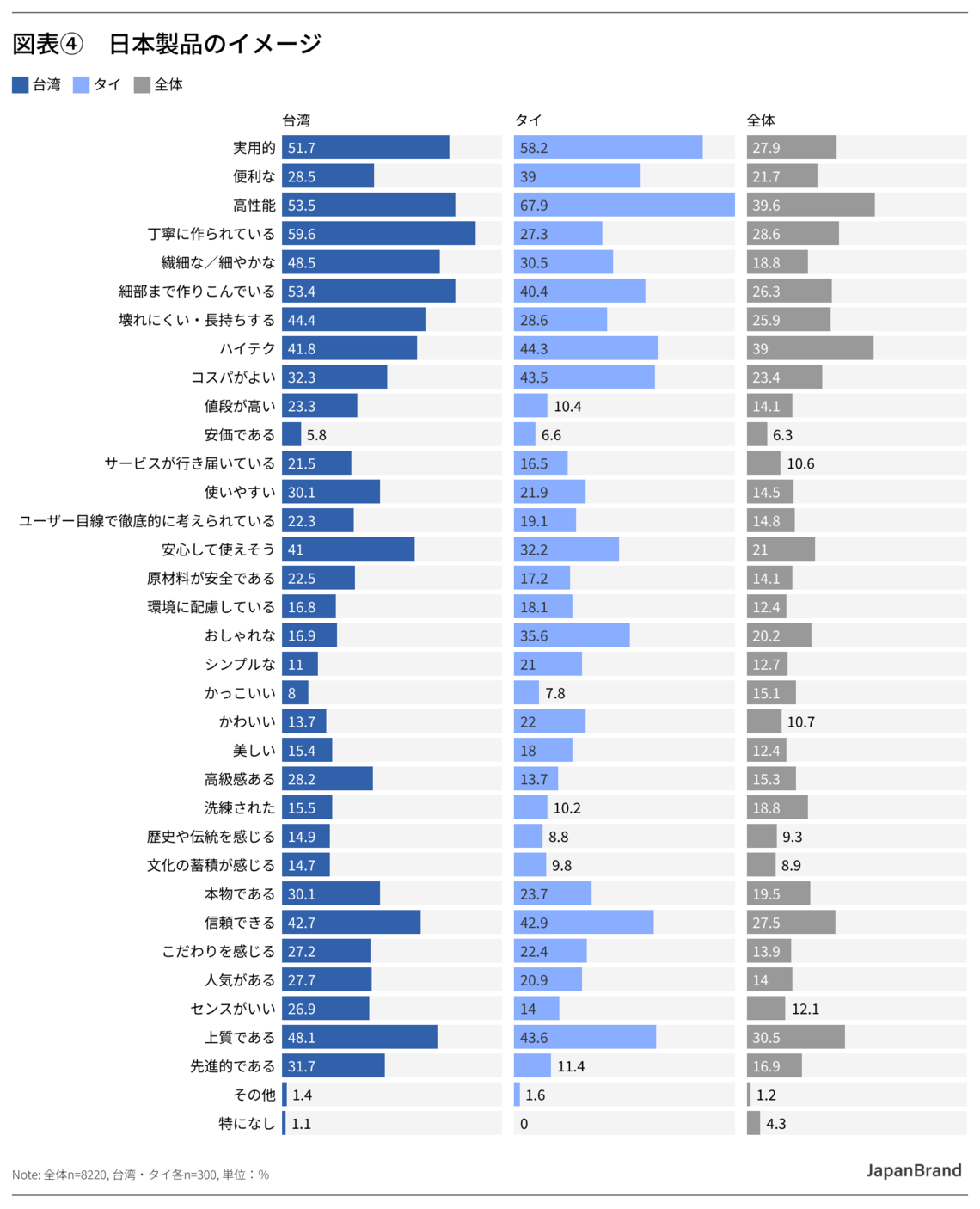
Turning our attention to Asia, we can see that significant differences exist even between Taiwan and Thailand, both of which have high favorability toward Japan. In Taiwan, images such as “meticulous craftsmanship,” “delicate,” “durable and long-lasting,” “luxurious,” and “advanced” are held very strongly, whereas in Thailand, these perceptions were not as pronounced.
It appears that for Thai consumers, Japanese products are more strongly associated with images such as “high performance,” “good value for money,” and “stylish.” Observing these subtle differences makes it clear that, even within the neighboring Asian region, it is necessary to adjust our marketing strategies accordingly.
Striving for the Ideal, but Never Underestimating Reality
In Parts 1 and 2, we presented various data points focusing on inbound tourism. According to the Japan Tourism Agency and the Japan National Tourism Organization (JNTO), statistics show that East Asia—which accounted for 70.1% (Note 1) of foreign visitors to Japan in 2019—also accounted for 64.4% (Note 2) of total spending by foreign tourists in Japan.
It is a fact—and a reality—that East Asia represents the largest segment of inbound tourism. The phenomenon of people flocking from neighboring regions that are geographically and culturally close is common in many countries; it is by no means unique to Japan.
I believe that, while firmly grasping this reality, we need to discuss and make decisions regarding the ideal vision (idea) of a tourism-oriented nation that Japan should aim for in the future, expanding our perspective both temporally and spatially. Needless to say, there will inevitably be a gap between this ideal and reality.Not limited to travel, inbound tourism has a broad scope, and since the “Idea” naturally varies depending on the sector in which businesses operate, it is easy to imagine that the resulting gaps are not uniform. Data suggesting these gaps was also confirmed in this survey.
When we surveyed intentions to purchase Japanese products, we found that in most Asian countries and regions, product categories representative of Japanese brands—such as televisions, refrigerators, washing machines, mass-market cars, and air conditioners—lined up at the top of the rankings. The high level of interest is evident even from the numbers alone.
In contrast, in Western cultural regions, in addition to mass-market cars and televisions, the response “None of the above” unfortunately also ranked high. Despite being presented with a list of options that covered nearly all major product categories, the fact that respondents deliberately chose “None of the above” is synonymous with a lack of interest.
In particular, the lack of willingness to purchase Japanese products in the United Kingdom, Germany, and France ranks among the worst in the Western world. This phenomenon is also evident in inbound tourism-related metrics; when aiming for business growth through promotional efforts or sales expansion targeting Western countries, extraordinary ingenuity in “Logos (logic), Ethos (character/trust), and Pathos (emotion/empathy)” will undoubtedly be put to the test.
If you know your enemy and know yourself, you need not fear the result of a hundred battles
The 5th century BCE, when “The Art of War” by Sun Tzu—which has many devoted readers in Japan as well—is believed to have been written, was roughly the same era in which the ancient Greek philosophers Socrates and Plato lived. It is truly fascinating that military strategies from such distant antiquity can be directly applied to today’s competitive strategies.
In inverse proportion to the increase in human life expectancy, the period during which companies can continue to win—and remain among the so-called “winners”—has become shorter than in the past. However, as long as free competition is required, companies must strive to win and survive. As the subheading suggests, in this article I would like to highlight the characteristics of Japanese products from the perspective of product image by comparing them with products from other countries (Germany, France, China, and South Korea).
First, I will briefly explain the product images of the four countries other than Japan.
German products have an image closest to that of Japanese products. Across many evaluation criteria, the two are in a tight race, and German products may be the true rivals of Japanese products.
French products stand out for their exceptionally high ratings in brand image and design—described as “stylish,” “luxurious,” and “beautiful”—which largely align with traditional perceptions of France.
Products made in China maintain their traditional image as “inexpensive” and “simple.” In particular, “inexpensive” stands out with a notably high score. Furthermore, in categories such as “easy to use,” “good value for money,” and “popular,” they are virtually on par with Japanese products.
Korean products seem to be perceived as “stylish,” “cool,” and “beautiful.” This is likely due not only to the increasing competitiveness of Korean manufacturing itself but also to a strong focus on global expansion and the country’s ability to consistently produce worldwide hits in content—the cornerstone of soft power—such as dramas, movies, and music.
As for Japanese products—the crux of the matter—has their brand value really declined to the point where we should be pessimistic when compared to these competitors? Absolutely not. In fact, there is absolutely no need to belittle them.
In fact, it is immediately apparent that Japanese products are highly regarded, particularly for their functionality. Specifically, it is clear that they hold a distinct advantage over products from other countries in terms of criteria such as “high-tech,” “high performance,” “meticulous attention to detail,” “durability and longevity,” “high quality,” and “reliability.”
However, as demonstrated by our failure to keep pace with other nations in building a digital ecosystem, it is only a matter of time before certain countries—where innovation occurs more readily than in Japan—catch up to and surpass us in terms of functionality.The spirit of pursuing the “ideal” of manufacturing centered on advanced technology deserves great respect. However, without being bound by it, we are increasingly challenged to understand both our competitors and ourselves, to view the “reality” of an ever-changing market with an open and impartial mind, and to make agile course corrections.
The Knowledge of Ignorance
Based on my own experiences, both professional and personal, I’ve observed that many people unconsciously tend to underestimate the diversity and differences of other countries or exhibit a subtle resistance to what is different.
In Japan’s case, the argument that “Japan is an island nation” is often cited. While I can understand this to a certain extent, for some reason I have never been able to deeply empathize with it. This is because, as an island nation off the coast of the Eurasian continent, Japan is a rare “mille-feuille nation” that has layered together diverse cultures from all eras and regions, offering unparalleled depth and richness. If one observes without bias, it becomes clear that the foundations for diversity and inclusivity have been laid throughout society.
I surmise that the root of the problem lies not so much in the geographical factor of being an island nation, but rather in the unprecedented success brought about by uniformity during a specific historical period, and the strong comfort zone that this success has created.In short, within a golden age of boundless growth and a highly homogeneous, high-context environment, there are few opportunities to confront differences among societies, organizations, and individuals. This can lead to a structural situation where people “are unaware that various differences objectively exist.”
While this is not unique to Japan—it can happen in any country or group—it is crystal clear that this is detrimental to the long-term prosperity of the “Japan Brand,” including Japanese products. And the most problematic pattern is that people “are unaware that they are unaware of the existence of differences.”
Whether it is “not knowing that differences exist” or “not realizing that one does not know that differences exist,” the concept of “the knowledge of ignorance” proposed by Socrates—who lived in the 5th to 4th centuries BCE—should serve as a valuable reference point for finding a solution. In short, it means taking “knowing that one does not know that differences exist” as the starting point.
Considering that this concept has continued to be recognized as valuable even more than 2,000 years after the era of ancient Greece, drawing inspiration from the wisdom of the ancients is precisely the kind of insight we need in these times of high uncertainty.
In summary, drawing on the timeless teachings of our predecessors—such as persuasion, multifaceted observation, ideals versus reality, contrast, and self-awareness and inquiry—and using the Japan Brand Survey as a foundation for understanding and recognizing differences, we have sought to interpret the ever-changing global consumer landscape and Japanese products.
In the hustle and bustle of daily life, are we narrowing our perspective by rushing to find concrete solutions or conclusions? Do we view global issues and diversity as concepts unrelated to the world we inhabit?It is entirely possible that, without realizing it, blind spots in our perception could cast a shadow over the rich, open spaces within each of us. To prevent this, we must not only diversify our resources and approaches but also intentionally create mental space for reflection. This may seem somewhat unconventional and abstract, but I hope it proves at least somewhat helpful. Next time, we’ll explore the world of food.
Source:
*1: Calculated based on the Japan National Tourism Organization (JNTO)’s “2019 Inbound Visitor Numbers”
*2: Calculated based on the Japan Tourism Agency’s “Annual Report on Consumption Trends of Inbound Foreign Visitors to Japan 2019”
URL of this page: https://www.mlit.go.jp/kankocho/siryou/toukei/content/001345781.pdf
[Contact Information for Inquiries Regarding This Matter]
Dentsu Inc., Japan Brand Project Team
japanbrand@dentsu.co.jp
Japan Brand Survey Hub Page
https://www.dentsu.co.jp/knowledge/japan_brand/
[Purpose of the Dentsu Inc. Brand Survey]
Launched in 2011—when the Great East Japan Earthquake led to reputational damage affecting Japanese agricultural and marine products as well as inbound tourism—this is Dentsu Inc.’s proprietary commercial marketing research initiative designed to understand how products and services originating in Japan are perceived globally.The Japan Brand Survey regularly assesses overseas consumers’ perceptions and actual behaviors regarding the Japan brand as a whole, covering areas such as overseas travel, inbound tourism, culture, regional revitalization, Japanese cuisine, Japanese products, and lifestyle. By visualizing shifting consumer sentiments and the challenges and potential of the Japan brand, the survey contributes to increasingly complex corporate activities while also promoting cross-cultural understanding within Japanese society.
[Dentsu Inc. Brand Survey 2022: Survey Overview]
・Target Areas: 22 countries and regions (United States, Canada, Mainland China, South Korea, Taiwan, Hong Kong, Singapore, Thailand, Malaysia, Indonesia, Vietnam, the Philippines, India, Australia, Saudi Arabia, the United Kingdom, France, Germany, Italy, Spain, Russia, Finland)
・Sample Size: 8,220 (Breakdown: United States 960, Mainland China 1,260, Other Countries and Regions 300 each)
・Survey Period: December 2021–January 2022
・Eligibility criteria: Men and women aged 20–59 (middle-income bracket and above)
・Survey Method: Online survey
・Research Organizations: Dentsu Inc. (commissioner), Video Research Ltd. (implementation partner)
[Notes and Disclaimers]
*1: The target areas in mainland China are primarily Tier 1 cities; in India, they are Delhi and Mumbai; in Australia, the Sydney metropolitan area; and in Southeast Asia, they are primarily metropolitan areas.
*2: Definition of middle-income group: Criteria were established for each country based on average national income figures (such as OECD statistics) and socio-economic classification (SEC).
*3: Samples were collected using equal allocation by gender and age group in each country and region, and the data was weighted to reflect the population distribution.
*4: Since the composition ratios in this survey are rounded to the second decimal place (or to the first decimal place where displayed as whole numbers), the totals may not add up to 100%.
*5: In creating the charts and tables for this survey, the names of the countries and regions analyzed use the international standard ISO country codes (ISO 3166-1 alpha-2/3), with a few exceptions.
United States/US/USA, Canada/CA/CAN, Australia/AU/AUS, United Kingdom/UK/GBR, Germany/DE/DEU, France/FR/FRA, Italy/IT/ITA,Spain/ES/ESP, Finland/FI/FIN, United Arab Emirates/UAE, Saudi Arabia/SA/SAU, India/IN/IND, Indonesia/ID/IDN, Singapore/SG/SGP, Malaysia/MY/MYS, Philippines/PH/PHL, Thailand/TH/THA,Vietnam/VN/VNM, Mainland China/CN/CHN, Hong Kong/HK/HKG, Taiwan/TW/TWN, South Korea/KR/KOR
*6: The names of countries and regions used in this survey report and on our website are based on the Japanese government’s long-standing position, as well as Japanese social norms and business practices.
*7: The names of countries and regions used in this survey are for statistical or analytical convenience only and do not imply any political stance or opinion.
*8: The maps used in this survey (world map and map of Japan) have been partially modified and cropped to suit the analysis content and page layout; therefore, they may not necessarily reflect national borders and territorial boundaries accurately.
*9: As a commercial marketing research study aimed at understanding the lifestyle habits and brand preferences of general consumers, this survey has been conducted consistently since its inception through commissioned fieldwork partners, in strict compliance with local laws, regulations, and public order and morals.Surveys conducted in China are carried out through fieldwork contractors who have obtained the “Foreign-Related Survey Permit” required by Chinese authorities; our company does not conduct market research activities within China itself. Furthermore, we monitor and review our operational procedures as necessary in light of developments such as changes in laws and regulations.
*10: The response data collected through this survey is obtained, managed, and processed lawfully in accordance with the relevant laws and regulations of each target market. The data we receive consists solely of aggregated data that has been anonymized in a manner that does not allow for the identification of specific individuals and cannot be reversed; it does not contain any personal information.
Was this article helpful?
Share this article


Newsletter registration is here
We select and publish important news every day
For inquiries about this article
Back Numbers
Author

Li Shunshi
Dentsu Inc.
First Business Transformation Bureau
Planner, Producer